173K
Downloads
141
Episodes
Deep conversations about divination, magick, art, and living a spiritual life in the modern world. { Hermits }
Episodes
Friday Mar 02, 2018
Friday Mar 02, 2018
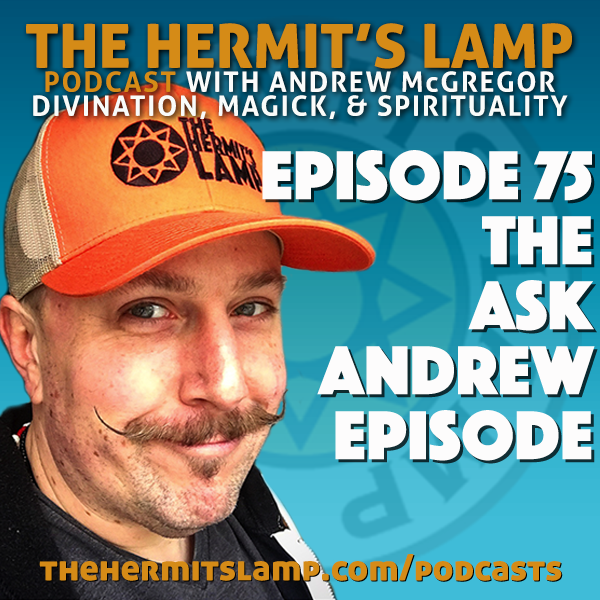
For the 75th episode of The Hermit's Lamp Podcast we decided to have a little fun. Get to know the guy who runs the show a little better with a fun Ask Andrew Episode led by the wonderful Fabeku Fatunmise! So join us for something a little different this week, see if your question get's answered and let us know what you think! Thanks to everyone who listens and here's to 75 more amazing, magick filled episodes, and guests.
If you are interested in supporting this podcast though our Patreon you can do so here.
If you want more of this in your life you can subscribe by RSS , iTunes, Stitcher, or email.
FABEKU: Hey everybody, welcome to the Hermit's Lamp podcast. I am Fabeku, and I'm here today to interview Andrew MacGregor, episode 75! Hey man, how are you?
ANDREW: I'm doing all right. How are you?
FABEKU: I'm good, thanks for having me in this position. We get to kind of switch it up today. I get to ask you questions, which is kind of awesome.
ANDREW: Yeah, for sure.
FABEKU: Yeah.
ANDREW: Yeah. It's kind of a once a year thing where I sort of turn the tables and sit in this seat for a change and, you know, get to experience the nervousness and discomfort which is having to speak about myself for an extended period of time.
FABEKU: [laughing]
ANDREW: So, yeah.
FABEKU: Perfect. So, let's dive into the uncomfortableness, right?
ANDREW: Yeah, exactly.
FABEKU: So, you know, I thought a good starting point might be ... So, in the last podcast we did together, we talked a lot about the dead, and the ancestors, and kind of that whole realm and relationships. I'm curious: tell me what ... I think, let's start with, what's the role that the relationship with the dead plays in your life? Like, tell me where is its place, and why is it such a big thing for you?
ANDREW: Hmm. So, I mean there's a couple layers to that, right? I mean, one of the things for me that exists with the dead, which is I have very easy access to them, right? If people are dead, and they're around, or want to be around, I can just converse with them, right? And so, that really changes my relationship to death, right? You know? I remember, a while ago I had this dream where an old roommate of mine showed up in the dream. And you know, in the dream we were hanging out in the kitchen where we lived together, and they said to me, "Hey, I'm dead! I just wanted to come and see if this would work, and if you could actually hear this message from me and know that I was dead."
FABEKU: Hmm.
ANDREW: Cause we had talked about these things a lot, sort of when we were roommates and stuff, and they were interested but skeptical. And, sure enough, I woke up the next day, and I was like, "Oh man, they died," and so I went and did some searching and found an obituary listing for them, you know?
FABEKU: Wow.
ANDREW: And, you know, so stuff like that is very interesting, right? And that changes a lot, you know? When my godmother passed away, I knew she was gone before I got the phone call, because I could see her standing in my living room, right? And I'm just like, "All right! So, it happened, eh? Okay." You know? So that's kind of the first piece of it, right? And so, when people slide over to the other side, I don't lose connection with them in the same way that a lot of people do, you know? And, you know, I have a shrine in the middle of my house which is literally like in the center of our main floor, right? When you walk in the front door, if you turn left, you'd be in the living room, if you go straight you'll be in the sort of kitchen and dining area and stuff, and right in that space at the bottom of the stairs going up, you know we have a dresser and on top of that are all the ancestors, right?
FABEKU: Hmm.
ANDREW: And so, they're always there, they're always included, and they're not all available, but many of them are always available to me. So that's one of the things that happens. I mean, the other thing that happens is that a lot of the spirits that I work with, you know when I'm working reading cards or doing magic for people, you know, those are also spirits of the dead, they are people that were alive at one point for the most part. And, you know, so I have these relationships with these spirits that are, you know, super clear and super helpful, and they provide me with guidance and they provide me with skills that I might not otherwise have. A number of them are happy to do work for me, when I need spirit work done, or for clients for that matter, and so there's this thing where, in that regard, I'm not the one always doing the work, when I sit down to read or when I sit down to, you know, do some spirit stuff for people. I'm actually part of a team of people ...
FABEKU: Mmmhmm.
ANDREW: ... who show up for this work, and so, you know, that counsel that comes from my one guide who's been, you know, who was a card reader in their lifetime, and you know, she's been dead for over 300 years now, right? Kicking around, following her descendants, you know, down to me, and hanging out with the ones that are doing this kind of work, because it's the work she did when she was alive, right? That is a kind of access that doesn't really fit a lot of other experiences, you know? It's different than book learning, it's different than, you know, other kinds of things, right? So. I don't know, does that answer the question?
FABEKU: It does, and so what I'm curious about ... So, when people start to work with the dead, the ancestors, spirits, it seems like one of the questions that comes up is, how do you know that they're around, right? So, you said if they want to be around, that you have easy access to them, and it seems like a lot of people struggle to figure out whether the spirits want to be around, or whether they're bothering the ancestors or not ... How does that come through for you? You know, outside of some obvious dream where a roommate shows up and then you realize they've passed?
ANDREW: Mmmhmm.
FABEKU: How ... What are the signs? What are the clues, for you?
ANDREW: So, I mean, let's talk about how it started for me. Cause I think that what I do now, that I've been doing it for 20 years, isn't super helpful a lot of the time to people, right?
FABEKU: Right, yeah.
ANDREW: Because what I do now is like, I see them there, and they talk to me, and we have a conversation, and it's not the same as you and I are having this conversation right now, but it's not that distant from that either. Right?
FABEKU: Mmmhmm.
ANDREW: But that's, you know, 20 years of doing explicit ancestor work and 30 years of magic and meditation and other things, right? But when I started doing this work, the thing that I started doing was, I started making space for them, and I started making time for them. And not in an everyday kind of way, but in a like once a week kind of way. And so, I set up a spot in my house, I had some pictures, I put a glass candle, and I would show up and I would say some prayers for them. And mostly I would say prayers that they would have appreciated, you know, I mean, my ancestors were Catholic and Anglican, for the most part, and so, you know. Our Father Who Art In Heaven and all that stuff. It's not my religion, it's not my belief, but I'm saying it for them, right?
FABEKU: Mmmhmm.
ANDREW: And so, I would show up and make time, and then I would have a feeling during that window of time. And those feelings, and those experiences I would really prioritize, right? Because at that point, I'm creating a clear space where I'm stepping into sacred time, I'm opening myself up to these spirits, I'm announcing to them, "Hey folks! Every Sunday, 10 a.m., you want to drop in for tea? I will be here."
FABEKU: Mmmhmm.
ANDREW: And then I kept that, right? And I kept that sort of practice for, you know, I kept that practice until that practice evolved to be every day, right? And I don't think that everybody needs to do that every day. I think that that is excessive for many people's lives, right? I mean, you know, I speak to them every day because, you know, five days a week, I'm working cards and spirit and I'm doing a lot of spirit work, right?
But for most people's lives, once a week is great. Keep it up! Keep showing up! And realize that you're there to give them something, which is prayers, energy, some light, an offering, whatever. And just let it build, you know? Because a lot of people, you know, the spirits, you're not going to bother them, right? Unless you're like showing up every week and being like, "But, but, how come this? and how come that? and why can't you make this happen for me?" Or whatever, right? Like, it's the same thing as it is for living people, right? If you're a bother, it's cause you're showing up every day and asking 'em for something, instead of showing up and being like "Hey, how are you? What can I do for you? Do you need anything?" You know, and if you think of it as building a relationship, then you're going to find that connection flourishes, and you're going to find over time that you and these spirits find your manner of communication.
FABEKU: I like that. And I like that idea of making like a regular space, establishing that rhythm, like "hey, I'll be here Sunday at 10," right? So, they know, you know, that space is there, the bridge is built, the connection is clear, I like that.
ANDREW: Yeah. Well, cause the other thing that happens is a lot of people, I think, get into a lot of trouble, because they're curious, and they're open, so then something shows up at 3 a.m., something shows up Tuesday afternoon, something starts whispering to them while they're on the subway, you know? But like, what is that? Is that your ancestors? Why are they being a jerk and ringing your phone at 3 a.m., you know? Like, what's up with that, right?
And so, you know, if you have this regular structure, then you can also have this regular expectation, which is, "Hey folks, unless, like, my house is on fire, don't bug me at other times, show up at that time, and let's have a really clean, respectful relationship." And because ... If you're sort of setting up this kind of practice, it will tend to insulate itself against other energies. And, you know, it's not a perfect guarantee but it'll be really helpful, and so you're not going to get random things cruising through your life and whatever, you're going to get your ancestors that are around. And then they're going to help hold that space and build it, right?
FABEKU: And how important do you think that rhythm, that regularity is, to that? Because I think that insulation piece you spoke to is important. How much ... How big of a part do you think that regularity plays to building that kind of container or that insulation up as opposed to just kind of sitting down and doing it when you want to or when you think of it or whatever?
ANDREW: Well. So. We've got to think about how do we reach these spirits, right? You know? And they're out there doing whatever they're doing. Right? Like, it's not like spirit is constantly sitting there, always, waiting for us, right? You know what I mean? They're not 24/7, you know, like Santa Claus watching us and seeing if we're good or bad, right? They're doing stuff. Right? And whether that's for other people, or for themselves, or things that we don't even really understand from this level, right?
So, if we have a structure, then they know where to show up, right? We've got some coordinates where things are going to happen, right? And, depending on the spirit and its relationship with you, it might be available more often, right? You know, I mean my guides that I work with are sort of continuously available to me for the most part. But that's an agreement that we've made and built over time, and that's an agreement that they're actually in part here to support and help me do the work that I do, because the work that I'm doing is the work that is their, part of their destiny to make happen, right?
But, you know, if we just show up randomly, it's not unlike strolling by somebody's house and knocking on the door. Are they home? Are they getting groceries? Are they sleeping? Who knows, right? But if we have this sort of regularity, then we can really sort of trust what's going on. And I also think that in time, it becomes possible to be more casual about connecting, once you really know the feel and the energy of the spirits, once you have ways to really trust who it is that's showing up. But in the beginning, if you're not sort of in the space that you've set aside to it and saying the prayers and going through that process that opens that door and closes that door, it's not as guaranteed what's showing up, right?
FABEKU: Mmmhmm.
ANDREW: And, I think that the timing of that is maybe less important than is the space for that, right? But even at that. Maybe also the timing? Especially if you feel like you walk by five days a week and you don't feel anything there, you know? Maybe they're really busy with other stuff, right? So.
FABEKU: Mmmhmm. Yeah. I like that. I like the idea of having a ... the words you use, coordinate, I like that. Right? It's kind of like, they always know where you'll be, at a certain time, and then they get to show up, and then you get to continue to build that bridge, deepen that relationship, do the work, I like that.
ANDREW: Mmmhmm. You know, and, I think that our job is to show up too, whether or not we feel them, right?
FABEKU: Mmmhmm.
ANDREW: I remember my ancestors wanted my partner and I to go to church before we got married, right? We weren't getting married in a church but a bunch of them were like, we want you to go to a mass. And we're all like, "ehhh, okay guys, if that's what you want," right? And so, we ended up at this Anglican church, which, had like a 5 p.m. on a Friday mass. Right? There was us and one other person in the space, right?
FABEKU: [laughing]
ANDREW: In this church that probably seats like three or four hundred people, right? And the priest came out and they did the mass, and ... And I remember sitting there watching them do the mass, and thinking, they would be doing this mass whether or not we were even here.
FABEKU: Mmmhmm.
ANDREW: That this is an agreement. I could tell that this was an agreement that they had made, in this case with God, what have you, but that they were going to hold this space no matter what, because that was their commitment and their practice. And I think that, you know, there's something deeply loving and relational about that, as opposed to kind of the more transactional spirit stuff that a lot of people, you know, myself included, started out with, right? Like "I really need a new job guys, you gotta help me out," 100 percent fair, but the more we find ourselves toward these deep lasting loving relationships with those energies, right? I mean, if they make sense for us to work with, the better, right? Because then, it's a completely different way of being.
FABEKU: Yeah, I like the relational piece of it, right? Because I think it is easy, to, whether it's intentional or not, to approach it like a transaction, and, you know, when there's the desire to dig deeper into these relationships, but yet, we're not really showing up, we're not really doing our thing, then to me, that kind of weakens the overall structure. It weakens the access and the experience of it.
ANDREW: Mmmhmm. Yeah. And it might be great, and they might not care, but they might really care, right? Or more still, they might really need something to help them, to help them help us, right?
FABEKU: Mmmhmm.
ANDREW: And if we're not feeding them in that other direction, then, you know, they may not even be able to help, even if they're willing.
FABEKU: Right. Yeah.
ANDREW: Yeah.
FABEKU: So, you said that work with the ancestors, that it's changed your relationship to death. Say more about that. I'm curious.
ANDREW: Well, I mean, I really feel this sort of continuum, right? Like, spirit people die and one hundred percent I miss them, right? One hundred percent I'm sad. But, at the same time, you know, so many of these spirits are just on the other side now, and I can talk to them whenever I want, you know? I got a phone call from the partner of a long, long-standing client, who had an ever-escalating series of really critical health problems, to say that this person had passed away, you know? And, you know, I knew it was coming, and this person knew it was coming, cause he used to come to me, and we used to sit and talk about it, cause most of the people in their lives were in denial about it, right? But they had, you know, they had open brain surgery, you know, to remove stuff. Like, big problems, right? And then, big fallout from that.
And, so, when I heard the news, and when I had some time, I sat down and I'm like, "All right. What are they doing? How are they doing? What do they need?" Right? And, and I could find them, you know, and I could feel them, and really, for the most part, what was going on for them was, they were just laughing their ass off now. Cause they were like, "Aw man, what a crap show that was at the end," and even despite that, despite their hardships that they had in their life, one of the things that was really quite amazing about this person was, they had a life that few people would understand or believe, and yet they still laughed a lot, right? And when I kind of connected with them, and I felt that laugh from them, I'm like, "Oh yeah, you're all good now, right? You know you're done? You're ready to move on, you're going to do whatever." I'm like, "Cool. You don't need anything from me." Right?
FABEKU: Mmmhmm.
ANDREW: And so that ability to sort of check, it leads less room or almost no room where regret has to live or where uncertainty has to live. You know, I feel like when it comes to, you know, specific spirits and my relationships to them, that I can know what's going on with them now in a way that is tremendously healing and brings closure and all that kind of stuff.
FABEKU: Mmmhmm.
ANDREW: Yeah.
FABEKU: Yeah. And how has work with the ancestors, how has it changed your approach to magic? I mean you mentioned the not just you doing it all, which I think is good and important. What else has changed for you in terms of the way you see magic, the way you do magic because of these relationships?
ANDREW: So, I mean, when I started out in ceremonial magic, right? I would be like, okay, I'm going to contact this archangel or that goetic spirit or whatever, and I'm going to get them to do this work for me. Right? And that would involve sorting out a ceremony, figuring out what they need to call them, incense, and candles, and all sorts of patterns, and other things to kind of get to that space where I would go through these elaborate ceremonies to get something done. Right? And, you know, I would time it to the minute with the, you know, with the sun and the moon and the ... You know, sometimes I'd wait, I'd be like, "You know what, it's going to be really good next month when the sun's here and the moon's there, right?" And I would do all these things, right? And that stuff worked. You know, and that stuff does work, right?
But, like, so, so I would go through this process and I would do this work and so on, right? And the ceremonies themselves would take a long time, usually. You know, cause you've got to, I would do banishings, and then other banishings, and then openings, and then callings, and, you know, and depending on the spirit would depend on how much I had to call to get it there, and you know and so on. So, it could take like an hour or longer to do these things. And, and then I would do what I wanted to do, or ask for what I want to ask, and most of the time it would work well. Occasionally a spirit would be like, "sorry, you called the wrong number, too bad on you."
FABEKU: [laughing]
ANDREW: Right? And then you got to go back to the drawing board, you know like, okay, you know, I thought that was going to work, but what else can I do? And so, I would have these things where, I'd always be looking for the windows where I could work, and looking for the constructs, and how to refine and elaborate these constructs to get me where I wanted to go.
So, now for the most part, I have a shrine for the spirits that I work with in this way, and generally speaking, a lot of it is very, like, straightforward by comparison. "Hey, is this," like, you know, I'll ask them, "Is this possible? Yes? Are you willing to do this work for me? Yes? What do you need?" And then I would get a list or an action or a thing or whatever. And then, and I'm like, "All right, is that it?" and they're like, "Yup," and then we're done, right?
FABEKU: Mmmhmm.
ANDREW: And I will, you know, sometimes I will do more elaborate things, you know, if I'm making powders or like, doing stuff. Sometimes there's process involved, or if I'm cleaning somebody, sometimes there's process involved, you know, of doing the cleaning and using the items and so on. But, the kind of work, for like, just straight up to open doors for things, or to consecrate talismans ... Generally speaking, it's like, "Yeah, I'm good, give me these things, burn this incense, you know, leave it here for a day or a week, we'll be done." And that's it and I walk away. You know? And the thing about that that's different is, even when I was contacting spirits before for things, I was using so much of my energy to make that communication happen, right? But now, there's no distance between me and the spirit, and there's none of my energy required for the actual work.
FABEKU: Mmmhmm.
ANDREW: In terms of actually making the work itself happen, right? So, I'm basically just being like, you know, "Hey? will you do this thing? Yeah? Does this work for you? Yeah? Done." Give 'em the stuff, leave it, walk away, come back, "Is it ready? Did you cook it? All right, let's go, done." And that's it, you know. And that's such a different level of effort, right?
And the other thing about it is, it also means because I'm relying on the spirit, versus you know sort of these other ways of working, I don't really care what the moon's doing, or the sun's doing, or Mercury's doing, or whatever, because I'm working specifically with one thing that's going to do the work. And either it will or it won't or it can or it can't, and that's the end of the conversation. And I'm not worrying about all these other aspects so much. So, I've kind of slid completely out of this sort of kind of contemporary Western magic witchcraft way of like, paying attention to all these different pieces, and into a very very direct way of working that is super fruitful and ultimately super easy.
FABEKU: Yeah. I like that. And I think that that totally reflects my experience too, right? It's not that I don't acknowledge the importance of magical timing, but I think you're right. There's other ways to work where it's just not, you know, it's not the deciding factor at all.
ANDREW: Mmmhmm. Yeah.
FABEKU: Yeah.
ANDREW: And ultimately for me, it's more powerful because it's more convenient. Right?
FABEKU: Mmmhmm. Yeah.
ANDREW: Because you know, I've always been aware that necessity trumps other considerations. Right? and having found my way to a way of working with spirits that I work with, where those other things that are required are no longer required, means that I don't have to like, you know, double my effort cause the moon's not full, right? Or, you know, double my effort because this thing's in that, or be extra careful cause Mercury's retrograde. I mean, you know, it's not to say that those energies don't influence my life in a more general way, but in terms of the actual pieces of work, they don't seem present at all, you know? It's like people ask me, you know, they're like, "Oh, there's a full moon, no, it was the eclipse," or "The eclipse is coming up," you know? "What does that mean in the Orisha tradition?" And I'm like, "Nothing. Doesn't mean anything."
FABEKU: [laughing]
ANDREW: I mean, it means that like, the Oshubwa's got a thing going on, you know? Maybe it might be kind of like this energy from this sign, like this is where we would find it, you know? Like, strange phenomenon in the sky? But it doesn't actually mean anything and it's not relevant. You know, it's not even a consideration, so.
FABEKU: Mmmhmm. Yeah.
ANDREW: Yeah.
FABEKU: So, one of the other things that I wanted to talk about with the magic stuff. Both of us are artists, both of us are magicians, and we both work with art and magic in some kind of clearly interwoven ways. So, talk to me about the way "art as magic" works for you in your world and your practice.
ANDREW: [laughing] That--what else is there to say?--art is magic! It's the thing! Right?
[both laughing]
ANDREW: So, I've been working on this deck called the Land of the Sacred Self Oracle. And, I've posted bits and pieces of it here and there. It doesn't exist publicly anywhere that I can kind of point to yet, but, you know, it's on my Instagram and stuff like that. And, when I started making this deck ... So, I was, over the last year, I made an Orisha tarot deck, and that deck was thought out and philosophized about and analyzed and whatever. And, not that it's not magical, cause I think that it is, but it was very cognitively driven as well. So that's one way in which I make art.
But when I started working on this Land of the Sacred Self Oracle, I took a more surrealist kind of open-ended dream-driven approach to it, right? And, what I want from this deck is, I want people to feel things, I want people to have experiences, I want them to be moved by it, and I'm not going to say anything about any of it, really. It's going to be a deck without a book for the most part. Because there's nothing to say about it. Right?
But when I'm making that work, right? For me, each of these cards comes from a place where I've been, and I'm sort of falling through the art back towards the sacredness of myself, and back towards the wholeness of who I am. And so, the process of making each of these cards is a magical act, right? And the actual act of making them is a way of creating magic that returns me back to myself from some kind of distance from that, you know? And I--when I'm feeling super connected, I almost never make these cards, because for me, they're about finding my way into this land where I am complete and magical and plugged into everything, and where I'm not caught up in taxes, driving around the city, problems with my, you know my kids are having at school, you know, whatever, right? Like all the life stuff, right? That can take us away from that spirit. These cards are gateways back towards that. Both personally in making them, but also, hopefully, as an artifact afterwards then for other people. Right?
FABEKU: Mmmhmm.
ANDREW: So you know, that's one of the things that I do, and then I mean a lot of the other stuff I do is around self-identity through portraiture, and so I do a lot of portrait work, well for myself and other people, where I am, you know, trying to align myself to a place where I need to be, or trying to shift some part of my ego, or my own actually way of being into a different place. And then I set those up and I have one on the wall right now that I'm sort of looking at, where I look at them all the time until I feel like I occupy that space, you know? And it came out of a conversation that you and I had about something, where we were doing some work together, and there was, the image that you gave me was, "I feel like your future self is very close, but it's right beside you but covered in a sheet."
FABEKU: Mmm.
ANDREW: And I was like, all right. So, I'm going to like, imagine myself lifting that sheet and looking at my future self and listening to what it has to say, and then drawing pictures of that, as a way of getting there. You know, as a way of, both sort of subtly, symbolically, nonlinearly, making changes that otherwise might take a very long time if I try to take a sort of more brain-driven talky approach to it. So.
FABEKU: And what is it about art? Why is art that bridge for you as opposed to writing about it, or meditation, or ... What is it specifically about art?
ANDREW: Hmm. For me, the act of making art is ... My whole system gets into it, right? Like, I can meditate and stuff like that, and I can sort of do spirit journeying, and like, you know I mean like there's many things that I could do, right? And I do some of those things at other times.
But the thing about making the art is that the process of it absorbs me, and the process of it reveals things to me through the process, right? So, like, I rarely, like when I'm doing these Land of the Sacred Self cards, for example, right? I'm like, what needs to be there? Oh. Giant egg? Okay, there's a giant egg, okay, it's floating in space, okay, and, it's actually hollow inside and there's a rabbit inside looking at a diamond, and there's a hole in the roof and there's a ladder that goes up to the sun, and the sun is throwing these things back down at the earth, and below the earth there's this cavern, and there's this journey that happens, right? Where it's created, and it reveals to me the things that need to be shown, right? The symbols, the patterns, and each step along the way is a process of making a change, you know? It's a ... it reminds me a lot of those sort of Tibetan Book of the Dead type things. It's like "Okay, so you're dying. Hey, you're dying, dude. Good luck. Go down the hall. There's a green door. Open the green door. Make a left turn. You're going to see a monkey. Keep walking." Like, I don't know. Whatever.
There are these pathways that we can be led, and when I'm making the art itself, some part of that sort of deep eternal part of myself, or other things leans in, and collaboratively we [inaudible] make the stuff happen.
FABEKU: And so, the revelatory piece ... tell me, how does that match up for you, being a diviner? Right? So how is that similar to and different from doing a spread of cards and looking at those set of symbols and how those things reveal pieces to us? How does the rabbit and the egg and the sun and the diamond ... How does that work?
ANDREW: So, with how I read for people when they're coming in for readings, with practical questions, it doesn't line up that much at all. I mean, I'm reading the cards, I'm predicting the future, I'm doing things like that, right? And, you know, I mean, all of that symbol interpretation and exploration is a similar skill, but it's not really the same. But, you know, and I talked a little bit about this in a Stacking Skulls episode that we just did, right? When I sit down every day, every couple days, and I read cards for myself, I look at the cards, I'm interpreting them, their meaning, I'm making some notes, and then I'm sliding into the symbols of the cards, or the visuals of the cards, and I start to abandon the meaning. Start to abandon the notion that that figure is even a figure. What if they're just a pattern? Right? You know, I start to look at things like where are there obstacles? Where are there ways through? And I start to slide into a very deeply poetic way of interpreting the cards.
And as I do that journey, it becomes very similar, it takes me into that space, right? And so, in that sense it's very similar to the process, and often coming out of that, I will end up with symbols or mantras or things that I'm working with, you know? And there's actually, there are actually sort of set symbols that recur to me when I work through the cards, and those mesh with what comes up in other places, but they're not the same, right?
FABEKU: Mmmhmm.
ANDREW: You know, there's this sort of crank arm with a gear attached to it that I see often and I sort of come back to, as I'm looking at the cards, and I find it in all sorts of places where that's certainly not what the artist of the cards intended, right? And it reminds me of different aspects of the work that I'm doing. You know, that crank arm doesn't show up anywhere in any of my other work, right? It is a tarot interface symbol for me.
FABEKU: Mmmhmm.
ANDREW: You know? I don't see, like the rabbit as a recurrent theme in the Land of the Sacred Self cards, it's not a symbol that usually emerges in card reading for me. You know, I mean, like, number one, there's no rabbit in the Tarot de Marseilles, but beyond that, I don't even see them in there, even if I could, right? So. So they overlap in a similar way, and they take me to a similar place, but the art part is more about moving around the internal furniture and shifting ego pieces or rebuilding ego pieces, whereas the divination part is more about getting myself into the zone.
FABEKU: Mmmhmm.
ANDREW: And keeping myself in the zone, you know?
FABEKU: Yeah.
ANDREW: It's more of a day to day piece and the art is more of a weekly or monthly, depending on how much I'm doing, but like kind of big picture piece.
FABEKU: And how does the art and magic piece come together in terms of the work that you do for other people, for client work and things?
ANDREW: Well, I mean when I'm doing these portraits for people, I do these portraits where I start with a photograph, and I step into the spirit world and see them from that point of view, right? And, you know, so I mean, what happens during that is, people get seen, that bigger vision of themselves, right? It gets revealed to them in a concrete way that they can look at and work with. You know, and when I do these impossible readings, which are sort of art videos that are set to sound and stuff, that are sort of transformational experiences, those pieces translate into a similar sort of shifting of their ego or their sense of self or their way of being in the world, that opens them up to bigger possibilities, deeper connections, and, you know, deeper openings, right? And you know, and then, I mean, secondarily, I mean it's totally, it totally is art, although not in the same way, I mean, all that stuff translates into my sigil work as well, right? I mean, to me making sigils is art in its own way, so.
FABEKU: Mmmhmm.
ANDREW: Yeah.
FABEKU: And what do you think it is about art and magic that those two things play so well together and have played so well together for so long? What's the ... Why is that for you?
ANDREW: Well, I mean, where ... Where haven't they played well together, right? I mean, if you roll back through, I mean, obviously, maybe it's just the remembering mystics and magicians and so on, right, but like, you know, look at Crowley, right? He wrote a ton of poetry. You know? Look at Austin Spare, you know? He made so much art. And even the people who weren't artists, right? or weren't known for being artists? They, so many of them, made art even if it wasn't sort of shared or, you know, consumed on a bigger level, right? I mean I think that there is just sort of, there is a direct possibility of a connection that's there, where the art influences the magic, the magic influences the art, and both open us up to different ways of seeing the world, and it allows us to sort of, kind of like remember and live in dream space ...
FABEKU: Mmm.
ANDREW: ... while conscious and awake, right? You know, I mean like, look at Carl Jung's Red Book, right? You know I mean that sort of active imagination piece. It's there in so many different sources in one way or another, whether literary or, you know, or visual or whatever, and I think that having access to that is a tremendous tool that, you know, if we can get out of our way to allow it to happen is pretty tremendous, you know?
FABEKU: Mmmhmm. Well, and I think there's something about both art and magic where you ... There's the whole working and thinking symbolically, you know, and to me that's really an equally important skill when it comes to the practice of magic and the creation of art or the experience of arts or, you know, whatever. It's this sigil, this candle, this plant, it's a symbolic proxy for whatever this piece is or there's the element of, you know, this, like you said, this rabbit, this sun, reveals a certain thing, that becomes a proxy for something. So, it seems that in some ways not only do they interface well but they're building similar muscles and using similar skills sets.
ANDREW: Yeah. I mean, they build a language for us, right? And they build a way of understanding things, right? And, you know, I mean it's like, I used to spend a lot of time looking at my dreams and writing down my dreams and analyzing them. And you know, I spent some time doing that with a Jungian analyst, for a few years, and, you know, those symbols very quickly became regular, right? Before they seemed chaotic and random, and I think that they were, right? I think that my unconscious and my shadow was trying to get my attention. And it was like, "All right, let's try a giant alligator. Okay, let's try falling. Okay, let's try shark attack! Okay, let's try a car accident. Let's try ..." You know, like things, right?
And, but when I started working on it, then the spaces that I was in became regular. You know, there was a smaller rotation of being in the same places, there was a smaller rotation of symbols that would emerge, and as I clarified what those things meant, then those symbols would not necessarily disappear, but they wouldn't occupy the dream in the same way, and then other symbols would emerge that would further clarify that. And I think that in the way that making art or building a sort of codex with spirits that you work with and stuff, you know, it becomes this thing, right? Where it's like okay, super super straightforward, and, you know, I mean, I do this and then that will help with this, or you know. This symbol is here, and oh wait, this symbol is emerging more strongly, and it's related to my anxiety, or my insecurity, or my fear, so I better check that, right? Or, you know, hey, this is warning me that this is a sign that shows up when I'm not paying attention to something that needs attention, maybe. You know, many things, right? But, yeah.
FABEKU: Well, the two things I like about that ... in some ways it kind of circles back to the conversation that we started with about the dead. The idea of making space, right? The symbols are initially kind of incoherent and all over the place, but the more we dig in, the more we give them space, the more we work with them, they're contained and they become increasingly coherent, and, I also like what you said about the language piece, right, because I think that there is something to both art and magic, where it's this sort of communication, whether it's communication to the audience, communication with the others, the invisible, and I think the more we understand that, and the more intentionally we build up the language, obviously just like learning any other language, the more skilled and adept we become at it.
ANDREW: Yeah, for sure. Right? I mean, so like, I talk to lots of people who are kind of starting out in magic, and they're like, "Do I need to learn kabbalah? Do I need to learn this? Do I need to learn anything? Why don't I just get it all from spirit?" And, if you can genuinely get it all from spirit, cool! Right? But that doesn't tend to happen very much. And it doesn't tend to happen in sort of one big revelation where they just download everything to you and now you're good to go. It takes time and there's a process, and, if you are working within a system, then it really behooves you to learn the symbols of that system, right? You know, I mean like, there's ... In the Orisha traditions, there's a proverb, which is, don't ask what you already know, right? And this proverb has SO many applications. But one of the applications that it has is, there are certain questions that you never ask cause you know that's just not how it's done, right? Like, you know what I mean, like if I'm going to give a pigeon to Elegguá, I wouldn't ask, I would never ask that question, cause it doesn't happen, right? It's not what's done, and so I never need to ask that question, right? But, and the more we know the questions that we can and should ask, or what symbols mean, or what the pattern of symbols are, the more we can remove all those sort of unnecessary questions, and therefore make space for deeper and more genuine connection. Which is kind of the opposite of what a lot of people, I see a lot of people sort of thinking, which is, I can just go to spirit and they can just tell me the things, and I'm like, that's cool, but that's a lot of work, right?
FABEKU: Mmmhmm.
ANDREW: It's a lot of work for spirit, and it's a lot of work for you, and if you don't already have a clearly codified relationship, you know ... And especially if you're working within a structure, then how do you know what's going on? And how do you know when you're asking a question that you shouldn't ask? And therefore, whatever answer you get is useless. Right?
FABEKU: Well, and that's the thing. So, I think in that way it's almost exactly like learning a language, because, you know, somebody I know is teaching me Romanian right now, I know maybe 30 words, maybe at best. [laughs] And so I could just say, well, you know, why don't I just intuitively express ... I don't have the vocabulary for it! I don't know the words! And the amount of effort required to get that to happen, like you said, is enormous. If I have access to 300 words, then that gives me greater ability to transmit what I want. And I think it's exactly the same thing when it comes to magic. You know? If you have the vocabulary you can use it.
ANDREW: You know ... in my mind you're wearing like a ...
FABEKU: [laughing]
ANDREW: ... one of those like black artist turtlenecks, and you're doing interpretive dance!
FABEKU: [laughing]
ANDREW: ... to communicate in Romanian to somebody. Right?
FABEKU: [laughing] Exactly! And I think there's a whole lot of magic that looks a lot like interpretive dance! [laughing]
ANDREW: Yeah!
FABEKU: So, one of the things I'm always curious about when I talk to magicians is, what's your magical origin story? How did you get into it? What was ... and whether it's the first ... they're the same thing or not, I'm curious, what's the first act of magic that you did, that really kind of solidified, "Holy shit, this is real," like "This is really a thing."
ANDREW: So, I was always into it. Right? Like there was never a time where I was not interested in magical stuff. Right? I mean, when I was a kid, it was colored by kid lenses, wizards and dragons and Dungeons and Dragons and, you know ... And, the inroad where I started to find things that were more real was actually through like, 80s ninja movies, right? So, me and my friends were watching these movies, and were like, "You know what'd be cool? We should start meditating like them. We should start learning." Right? And, so we set up this space in my friend's suburban basement crawl space, right? We got some paper that was, we thought was rice paper, but whatever it was ...
FABEKU: [laughing]
ANDREW: It made this little ninja room in the back, right? And we would crawl in there, and we would light up our incense, and we would sit and meditate. Right? And, then coming out of that, I started doing martial arts, and when I started doing martial arts, I started learning to meditate, right? And the person that I was studying from at the time, you know, he would sleep for four hours and then meditate for four hours every night. That was his deal. And he would do transcendental stuff, and he would do other things, and we did this meditation where, whatever we did to get there, we started to shrink. And he's like, "Just get smaller, get smaller, notice the mat you're on getting bigger," and in the meditation, he led us through to sort of dropping through the pores in the concrete on which we were laying. And looking at other things. And, some of that really started to open me up into other possibilities, you know? And, you know, around that time, I mean I'd already been excited and interested in magic, and I was reading a lot of like fantasy and stuff like that that tied into that, and you know, I found some books by Aleister Crowley, and you know, I found a bunch of other occulty-type books, which, you know, were 80s classics, like The Necromonicon, and ...
FABEKU: [chuckling]
ANDREW: ... the Satanic Bible!
FABEKU: [chuckling]
ANDREW: But I started reading all this stuff, right? And, I started trying to think about it, trying to understand it. You know? And so, that was kind of the start of it for me. I don't really remember, like what the starting of doing magic was as such, you know? I mean, I remember trying to read, in Magic in Theory and Practice, Crowley's description of the banishing ritual and trying to do something with it, which is horrible. There are no actual instructions, right?
FABEKU: [laughing]
ANDREW: In retrospect, actually knowing what is meant by it, I'm like, "Dude, you're a horrible technical writer!"
FABEKU: [laughing]
ANDREW: But you know, like, yeah, but like, at that time, I was very interested in a lot of stuff, and mostly, especially because when I was 14, I almost died in an accident, I really just wanted to understand things and know things, you know? And so, I just started reading everything, and talking to people, and, you know, kind of, you know, making art that was sort of heading in that direction. I was always making art, right? Ever since I was a kid, and I look at the art that I made leading into, you know, leading out of high school and into going to art school, and it was all psycho magical surrealist kind of things, right? You know? And, yeah, so.
FABEKU: And what is it about magic that's kept you doing it for 30 years? What's the thing that keeps you moving in this direction for three decades?
ANDREW: Cause life is fucking hard!
FABEKU: [chuckles] Yeah.
ANDREW: If you, like, if you have some mechanism through which you can make life easier, and especially if you have some mechanisms where you can up your capacity to cope, or your resilience, then, then that's the things to keep doing, you know?
FABEKU: Mmmhmm.
ANDREW: Cause, like, life is no joke, right? It is not easy, and even when things are going well, it's often difficult, you know? I mean, there's just a challenge to persisting, right? To fighting with entropy all the time. And, for me, magic is that thing that allows me to be resilient, to roll with stuff, to manage things, to keep showing up, right? And, AND, to keep being available to the things that I want, right? And where there's a distance between the thing that I want, and where I am, you know, it helps me bridge that distance, it helps me get there, so.
FABEKU: I like that, a challenge to persisting. I think that's an incredibly accurate way of describing it.
ANDREW: Mmmhmm. yeah.
FABEKU: So, one of the questions somebody asked, and this might be a good way to wrap. I'm curious. They asked, "What's the most challenging thing about being you?"
ANDREW: [chuckles] I mean, the most challenging thing about being me is being me. Right? It's also one of the great things about being me. I live in a way that other people don't really understand. Right? I mean, you know.
And I don't mean, like, woe is me, nobody gets me, and I'm going to sit around and wear my black turtleneck and smoke clove cigarettes, right? and drink, you know, drink port all day, or something, right? Like, you know, it's not in that like gothy angsty teen way, but my reality is really really different from so many other people's, right?
Practically speaking, I mean I run my own store; I make my living, you know, reading cards and doing spirit work for people; that in and of itself is different than, you know, 99.99 percent of the population, right? You know, I'm a priest in a Afro-Cuban religion, which is quite different from most of the other people. And even where there's the appearance of overlap, right? Like, many people are often like, well, like, you're just a pagan, right? Why don't you just hang out with pagans? I'm like, well, I mean technically you could see it as a pagan religion, but really it's a monotheistic religion, and, you know, and it's not that I have anything against pagans at all. But their relationship to spirit and especially their relationship to Orisha has no real resemblance to mine. And practically speaking doesn't have any real overlap. It's very different, right? It's so different in that regard, right?
And so, in many ways, my challenge is to really be authentic and honor all the stuff that I'm doing, but then to also not let that separate me or isolate me from the world, right? To like continue to be engaged and continue to stay in the world and doing things in the world that keep me connected to people on a more sort of, on other levels, right? You know, and to sort of always be working and looking to understand commonality through, you know, through these things that are pretty radically different, you know? So. Yeah.
FABEKU: Mmmhmm.
ANDREW: Cause it's easy to start to feel like, oh, I'm the only person like this that I know, and that's not entirely true, but you know, it's not that far from being true, in many ways, right? And, you know? So. Yeah.
FABEKU: And how does magic keep you engaged? Say more about that piece.
ANDREW: I mean, so, like my practice of working with my ancestors, and working with, you know, spirits and the Orishas and stuff like that, you know, I mean, those things keep me engaged because the spirits keep being like, "Dude, don't herm it up! Don't go, you know, don't go live in the woods! Don't disappear!" Right?
And, they also sort of help me keep a perspective on ... It's easy, and I see both myself and other people at different times doing this, right? See things that mark difference, and sort of use that as a way of creating distance. Right?
FABEKU: Mmmhmm.
ANDREW: Or justifying distance or allowing distance to be there, right? And, so, you know, I'm sort of, always sort of leaning on spirits and advice from spirit and guidance from divination and other things to keep myself from what might be a natural inclination to be more distant from the world, you know? And so, it keeps, they keep pushing me back, and then I use things like making art and sharing it and stuff like that as ways of creating connection. Right?
You know, I mean, in some ways this podcast, right, is a way of me creating and sharing connection, because I value the dialogues that come from doing this work and the way in which that keeps me engaged and keeps me connected with people whom I might otherwise not necessarily have a connection with or see a connection with. I create that and even if there's different ideas or disagreements even, that doesn't really matter, cause we're still connecting. You know?
FABEKU: Yeah. I like that. The whole connection piece, it's a big deal. Yeah.
ANDREW: It is a big deal. You know? And I think that it's a thing that, you know certainly I saw it in the ceremonial community when I was in that community, right? Lots of people separate themselves from the world by virtue of what they're doing, but I always go back to, there's a line from Crowley's Gnostic Mass, which I used as a mantra for a long time. Which is, "I am just a man amongst men. How will I be worthy to administer the virtues to the brethren?" Right? And like, that sort of piece of making sure I'm keeping myself in check if any arrogance is emerging, making sure that I'm recognizing that I have to both serve people in spirit, you know, cause those things are both part of the equation. You know? And just sort of noticing that my role is to be here on this world and be a part of this world, not just to disappear into the spirit realm, and, you know, wear a fancy hat and fancy robes. As much as I love my fancy robes.
FABEKU: [laughs] Well, you know what I love about that is I think that, to me, that's an important point that sort of stands out in a lot of conversations about magic. I think there's ... Often, and I've done the same thing, there's a conversation about kind of the outsiderness of magic and magicians, which I get, and I, you know, there's certainly kind of an Other component to it, but, I, what I like about the way you're talking about it is the way that the magic reengages you with life, so it decreases the distance instead of increasing it, which I think is ... Yeah, I think that's a different and really important point.
ANDREW: Yeah. And you know, the more I am brave about that, the more I find that people really just engage with it, you know?
FABEKU: Mmmhmm.
ANDREW: And people are just open to it in a way that's just like, "Oh, okay, cool!" You know? And like ... And granted I live in a relatively progressive city, right? You know, I mean I don't live in a super conservative kind of, you know, negatively religiously judgemental space, right? So, I mean, obviously my circumstance is not everybody's circumstance. But like, you know, the, I get tremendous support for my business from the city and from the provincial people and you know, like, I'm, and I just, go and engage with those people and they just recognize it as legitimate right from the get go, and just work with us, you know, and, you know, I'm just really open about those things. I try to be really open about what I'm actually doing and so on, and, you know, so many people have all these worries and anxieties about that, right? And, you know, you might find that there are problems. I run into some really weird stuff, you know. I had a cute couple of people sort of yell at me outside the store at different points in time or whatever, but, that's almost never the outcome that I get, you know?
FABEKU: Mmmhmm.
ANDREW: And, so, I mean again, I live in a progressive city, so there are places where obviously that's more of a challenge. But you know, I think that, you know, that being open and being engaged and being just like, these are the things, this is what I'm doing. I think that that gets us further than sort of, you know, cloistering in our temple and, you know, reading a lot of books.
FABEKU: Yeah.
ANDREW: Not that there's anything wrong with books.
FABEKU: [chuckles] Very well said. That seems like a good place to wrap our conversation, yeah?
ANDREW: Yeah, absolutely! Thank you for being the host.
FABEKU: No, thanks for having me. This has been fantastic. Congratulations on 75 episodes! I'm excited to see what's next for you!
ANDREW: Thanks man.
FABEKU: Absolutely.
Friday Feb 16, 2018
Friday Feb 16, 2018
Andrew, Aiden, Fabeku, and Jonathan are back with a surprise or two coming your way this episode. We start by catching up, and discussing the events of the past couple of months and end with some amazing questions from our listeners! Check out our past 2 episodes if you haven't yet. Full episodes and ways to connect with the skulls can be found in the links below. *EXPLICIT EPISODE ALERT*
Click here to listen to the first chat by Stacking Skulls.
Click here to listen to our most recent one.
If you'd like to learn more and sign-up for the Ancestral Magick Course, click here.
Find the Stacking Skulls Shirts, and all other types of merch here.
If you are interested in supporting this podcast though our Patreon you can do so here.
If you want more of this in your life you can subscribe by RSS , iTunes, Stitcher, or email.
ANDREW: So, there are two quick things I want to share with everybody before this podcast gets going. The first being, Stacking Skulls now has shirts. That's right: they are on my website. If you go into the product section, you'll see a section for shirts. Or you can just search for Stacking Skulls and you will find them.
And secondly, we spent a lot of time talking about ancestors in this course, and coincidentally, or perhaps synchronously, I am running my ancestral magic course, which is an opportunity for everybody to learn some brand new divination tools that I have created so that they can build a tighter relationship with their ancestors, either known or unknown, and start to learn to work some magic with them. So, if you're interested about that, jump over to TheHermitsLamp.com and slide over to the events page, and you'll find it. Without further ado, Stacking Skulls, my friend.
[music]
Welcome to the podcast, folks. Just to give you a heads up before we start: there were some technical issues with Jonathan's microphone. We've trimmed them and cut it, so it flows, but if you run into anything strange, that would be what was happening.
[music]
Hey world! We're back: Stacking Skulls. This is the magnificent first show of 2018 with all four of us wonderful wizards in the same place. Thanks for tuning in again. And, if you have not listened to the previous rounds of shenanigans, you may want to go back and do so, or you may want to bypass that entirely. I'll leave that in your hands. You know? But there are two previous episodes or installments of myself, Aidan Wachter, Fabeku, and Jonathan Emmett, and you know, we've gotten together a few times and talked about some things, so I'm going to kind of lead us off, though, with our kind of starting point thing, which is, like, hey folks, what's new in the last three months since we last all hung out together?
JONATHAN: I had a microphone up my butt.
[laughter]
ANDREW: Excellent. Now, the explicit tag!
JONATHAN: Next, Aidan's turn. [laughter]
AIDAN: You know, this has been like the craziest three months ever. Right after we recorded the last time, my son died, and that was a really huge and transformative thing. And it's hard to describe it anyway, but...there is like a massive massive hole there and loss there, but it was also incredibly beautiful. We were able to get him home from the hospital, so that he died in his back yard, with a bunch of friends and family around. It was easily the most magical and beautiful thing that I've ever seen.
And then, I had surgery. And now I'm pretty much recovered from that. And playing catch-up in the shop after those two things, and as of last night I'm now a double grandfather, as Ash’s partner, Desi, just had twins last night. And they're beautiful, everybody's good!
ANDREW: That's amazing. Yeah. Whenever I've gone through big losses in my life, you know, like two of my brothers died within six weeks of each other...
AIDAN: Whoa.
ANDREW: And, I always find myself at those times, in, like this sort of liminal space, right? You know? Like where I just sort of end up where I'm like, I feel like I'm constantly in ceremony for some period of time afterwards. And surgery does that, and, you know, I mean, for me, having kids, I don't have any grandkids, but having kids did that. Do you feel like you're still kind of in that, that kind of space? Are you like, sort of living 24/7 in there, or...?
AIDAN: It's really wild, because, I think in the last episode, we talked about that I have these kind of death spirits that I've been hanging out with for a couple of years now. And in the week that I think I talked about, how they've gotten really busy, leading up into it. And so, that had become this, like, every night crazy kind of spirit initiations with these kind of hive beings that their thing is death, that I call the sisters.
And so, when he, when I found out that his heart had stopped, that they had him on life support, I went in and they were totally waiting for me, and so it was very odd, cause they'd clearly been setting me up for this thing, for a couple of weeks. And so, I went straight in to go find him, where he was, kind of stuck in between, and assist from there. And so, the combination of all of that and then actually flying out, I guess two days before he was, we actually removed him from life support, and going through that process there, it's the most complete thing that's kind of a major event that's happened to me, as far as kind of fully self-contained in a way, of anything that I've ever experienced.
So it's very odd, cause in many ways, I just feel really really good, you know, and I'll get hit at points, you know when I've been doing work for Desi and for his babies, there'll be these moments that are very very sad, but it's really just about, I know how much he would have liked to have watched the thing, and met them in the flesh and done that whole thing, that was really important to him, but what I feel like is this huge shift. You know, you have those moments in your life when you can feel like the cogs in the wheels of the machine are always turning, right? And to me, we're always trying to like, smooth that out and gauge where it's going and gauge what the next configuration is going to be. And this feels, in a really crazy way, like it's the smoothest kind of complete snap of things. So that's really what I have more than it being anything else. And like, just mass clarity. So there has been a huge amount of work going on, but it's really been, like there's a ton of stuff that, I don't need that anymore, I don't need to think about that any more, let's do the work to finish that piece off. About things from my childhood, and, you know, social dynamics, magical dynamics, all that stuff. There's been a lot going on, definitely. But so far, it's, you know, it’s weird to say, in that situation, that everything seems really good. But it does.
ANDREW: Yeah.
I mean, it's certainly my experience of... Well, it's one of the reasons for the practice, right? You know? Whether that's Fabeku's The Practice, trademarked, or whether it's just having a practice, right?
AIDAN: Yeah.
ANDREW: I mean, you know, I think that there are... Ideally we get to these places where there's grief, there's loss, there's whatever, right? And there's the hole, and there's the absence of that person from experiences, and the feelings that come from that, right? But then there's also this capacity to be like, I find myself at various points thinking, other people seem like they feel like I should be way more upset about this...
AIDAN: Yeah....
ANDREW: ...than I am, and I have this sort of very deep grounded position around it, where it's not avoidance or denial, cause it's actually almost like a hyper level of looking at it so squarely that it becomes easier to accept it, or to recognize it, and to see the ways in which that is, as you say, maybe that, the moving of the cogs, the machinery of the universe, the inevitability of some kind of fate force or, or just something that is just beyond our control at this point, either way, whether it was destiny or not, you know.
AIDAN: Yeah. And I think, yeah, that in spades, and it's really interesting, because it’s also, and I'm sure that all of you have had this experience, that we do all this work, kind of in these liminal states, or... ceremonial work or ritual work, not in a ceremonial magic sense necessarily, but just the work dealing with spirit, and dealing with the universe at large, what I call the field, and periodically, there are things that happen that really make you realize you haven't done your work in some places? [laughs]
ANDREW: Mmmhmm.
AIDAN: That you're like, “Oh! That smashed me!” Right? And I've had a good number of those. This was the reverse of that. This was like, I got the news about him, I went in, the allies that I work with were like, really sweet, and like, okay, you now know what we've been up to with you, let's go do it, you know? He's here, he's stuck. Let's fade him. And that's the most beautiful thing that I've ever experienced. And to me, it is, it is the, yeah, you can do money magic, you can do attraction magic, you can do whatever, but to me it's that: How is the work assisting your reality in the actual reality that you're in?
ANDREW: Yeah.
AIDAN: And this was totally solid.
ANDREW: Yeah.
AIDAN: And it remains totally solid. And I feel like at least the people that I've dealt with closely that were close to him all get that, in a way that I've never seen around someone's death before. And I think it is people who were doing the work, and who are...
I have this knowledge that I've had since I was a kid, that I kind of realized what historical life expectancy of humans was, and the numbers that even got anywhere close to there, and what infant mortality rates and childhood mortality rates are, and so since I was a little kid, I've had that knowledge of that. Like, this is a totally iffy thing. You don't get to stay, and you don't get to pick when you leave, and far more leave sooner than later. You know?
ANDREW: Mmmhmm.
AIDAN: And, I've had that. I was in San Francisco, at the kind of height of the AIDS wipeout there, and so that's also, I think, you know, at an early age, I lost a lot of people. And so, it was really interesting seeing this, and going like, this is the most okay I've ever been about having somebody cross over. But I think that that's really tied into the work that I've been doing for the last five or ten years. That I could actually be there with it as it was, and go, okay! This is, me, it doesn't matter what I want here, I'm irrelevant in this situation, so...
ANDREW: Mmmhmm.
AIDAN: I would help the process that's actually happening, to happen in the way that it's supposed to, you know? But yeah. That's what I've been up to. [laughs]
ANDREW: Yeah. Well. It's affirming to hear you talk about it. Do you know what I mean?
AIDAN: Mmmhmm.
ANDREW: Because, because I think that there are lots of ways in which, especially certain kinds of conversations around magic can feel sort of superficial and transitory, whereas this sort of, the deep work of, I don't know what you would call it, elevating oneself, healing oneself, harmonizing with that universal, the cogs of the universe or whatever, you know, I mean, to me that work has always been the most important work, but it is, except, you know, except when you lose a wheel, you don't notice it, right? Like there's no way to really sort of see it in action, and then when you see it, you're like, “yeah, it's so good that I practiced all that driving with three wheels, cause, one just came off, and now I can stop safely and put something else on there and see what happens next, you know?” So.
AIDAN: Right. Well and I think it also syncs into that concept that kind of connects to a question that we had that, in passing, which is this kind of, there is this direct relationship in my mind from what we now are viewing, the pieces that we can see of it, anthropologically, as shamanism, right, which is this, to me, this epic chain, of shamanism and magic and sorcery and whatever you want to call it, spirit work, that goes back as far as we go back. And I think that this kind of thing is the root of it, you know, it's about... The reasons for all the kind of death mysteries are not because there's some way out of it! [laughs]
ANDREW: Mmmhmm.
AIDAN: It's just, this is a reality that is the most prevalent reality other than the birth one, right? And that's that, the wild thing about this to me is that, you know, he's gone now three months almost exactly, and his children are now here as of yesterday. And I think they’re going to have a really... They have a fantastic mom, who has a fantastic network of people, and I think they're going to have really fantastic lives, and yeah, there'll be that piece that they didn't get, but he's like, he's an epic, mythic creature for anybody who kind of has watched this, it’s like, and I don't know that that's a benefit or a drawback, to grow up with that! [laughs] Without getting to see some of the grungier sides of it as a kid. Yeah. But, they're going to be special people. They've got special people all around them.
ANDREW: Yeah.
JONATHAN: You know, I was kind of thinking, while you were talking there, it kind of makes you wonder if he had to leave so that they could be born, in a way. I mean, just, the surrounding, everything surrounding the situation of how it just kind of happened, it really was no warning of any sort or anything, I mean it just kind of happened. It just, it makes you wonder, you know? I think about weird stuff like that. But it does kind of feel like he had to go so they could be here. You know, it's kind of a change of energy or exchange of... the...
AIDAN: Mmmhmm. No, I totally, you know, it's one of those things that again, we never get to have those answers in any…
JONATHAN: Right.
AIDAN: …definable way, but the thing that I saw, through the time that I was out there when he was in the hospital and then when we brought him home, and had, I don't know, there must have been 20 or more of us in the back yard with him... …Was, you could see the transformation happening on all of those people. While it was happening, I was like, either you could see that there was a way in which this thing was a huge gift to all those people, to see someone's death happening and it being processed by the people close to them into my mind, the most beautiful way that you could hope for, you know?
JONATHAN: When I was 12, I think I was 12, I was pretty young, anyway, my grandfather, loved this man dearly, he was just one of the coolest guys in the world. He taught shop in east Wichita, in, you know, some of the toughest parts of town, and he was Native American to top it off, so you know he probably didn't get treated very well, but he was just such a good man, it was hard for me to let him go, but… I was 12, and he had a death rattle, and I don't know if people are familiar with... It's not the worst thing in the world, but it's not pretty to listen to... And I remember my parents left, and I was just there in the room with him by myself, and our preacher at the time, she wasn't really a preacher, more of a spiritual leader, came by and we were talking, and he started having the death rattle again, and she went to get a nurse and he died. And that was my first experience with death, at such a young age, and it was... It didn't devastate me, like, "oh, I saw somebody die, now my world's over," it was just, it was kind of fascinating, but you know, it broke my heart, because it was my grandfather. So, I kind of understand that, I mean, it's an interesting process to watch someone actually leave [static] you know and that was [static] on several...
AIDAN: You're breaking up...
ANDREW: Yeah, turn off, your microphone’s suffering from what you've done to it, it's going in and out, my friend.
JONATHAN: Is it? I broke it.
AIDAN: In and out! I see how it is.
JONATHAN: How's that? [laughs]
ANDREW: It's good.
JONATHAN: So, I should keep my microphone out of my butt. Anyway...
ANDREW: Let's [laughs], on the segue of Jonathan's problematic microphones, what's going on with you, Fabeku?
FABEKU: Yeah, it was... it's been kind of an interesting few months, you know, it was holiday stuff, and you know, weird, I'm not, I don't love holidays anyway, but this one was a little weird. You know, my mom's getting older, and has some health stuff going on and that's been...not so great, and with that, there's some weird cognitive stuff that's starting to happen, and I think it's interesting, cause I was relating in a different way to what Aidan was talking about with... You know, it's been interesting to kind of look at that cycle of her, she's in her eighties, and, you know, kind of getting to that phase where things are becoming kind of difficult and problematic, and it's interesting, kind of watching the other people around her, and kind of their stuff that's happening with that, and you know, the kind of the... the sadness, which I get, but kind of the panic and the fear and the weirdness and that kind of thing...
Had a chance to talk with her a little bit in the busyness of the holidays, just kind of where she's at, and it was interesting, like she, she mostly felt okay with things, until everybody started freaking out, and then she got kind of fucked up and worried about it, and you know, so we talked a little bit about that, kind of managing other people's shit, and you know, we talked about ancestor stuff, and it's interesting, cause she, I mean, her background couldn't be any more different than mine in some ways. She grew up in a super religious Pentecostal home and music was "of the devil" and, you know, all of that kind of stuff, so, we have pretty different philosophical takes on things, but, yeah. We, it was a good conversation, we got to talk about the ancestors and kind of crossing in a good way and being met by the ancestors and you know, I, we talked about kind of my practices with that a little bit, and I asked if she was all right with me kind of working with the ancestors to, you know, kind of do what they need to do so when it's her time, you know, it can be as smooth of a transition as possible and, you know, it’s again, like this is, it's a weird conversation to have with somebody.
But to me, like we've been talking about, this is why we do this work, you know, I'm all for money magic, I'm all for all of this other stuff, that's fantastic, and, you know, when there's giant life shit like this, yeah, these are the moments when I feel really super grateful that we do what we do, and we have this stuff available to us. You know for me, it, I was thinking about this a few days ago, how these practices become, at least for me, these shock absorbers. You know? It's not that it prevents shit from happening, but when it happens, it allows us to stay more oriented and more coherent than we would be otherwise, and, you know, then if that extends out to the people around us, then we can help them get or maintain a better sense of coherence and orientation, and that's a pretty remarkable thing, to me.
ANDREW: I think it's such a significant point of view, right? Because so many people lose faith because they do stuff, religiously or spiritually or magically or whatever, and then some life thing comes along and they're like, “why did this not get prevented?” Right? You know? And then they falter because of that, right? You know? Like I remember, a day and a half before my second brother passed away, I was divining with the Orishas, right? And I came on this really bad sign, right? Basically, a sign of unexpected things and tragedies that shake your whole world all the way down to your foundations, right?
And so, I did what I do when stuff like that shows up. I basically called all the people who are important, you know? And I knew that he was going through a hard time, and so I called him, and I was like, "dude, come to my house, come over here, you know, I know you're out doing whatever, but, like, come over here, you know, after work, come over here, I'll come pick you up, come over here," right? And he decided not to, you know? And then that, ultimately, that decision that he made led to his passing, you know? And you know, there are these flags that I think that are there that warned that something's coming, right? You know? Like, gird your loins, put on your armor, get ready, shit's going to get shaken up, but it's rarely ever as clear cut as anything else, and to me that doesn't diminish my faith in these processes, because the warnings and the advices of that reading carried me through that time in a way that I could have been, it could have been so much worse for me, without that, you know? So. Yeah.
AIDAN: Yeah. It was interesting, when I went out to Athens, I took out a deck of cards that I had just got and decided I was going to take that with me, to be my thing, and I'm not a big diviner, I don’t, if I do a reading a week, that's a lot for me. And, as I was moving through, whether this was on the plane, or off by myself getting dinner at some point, and there was a sum process coming up, I would ask the cards to show me what would help me.
ANDREW: Hmm.
AIDAN: It would give me these readings that I would interpret in some particular way, at that moment, and I would invariably be completely wrong, but having that information in my head, and expecting things to go a particular way, was like the most perfect "assistance" I could ever get, which was what I basically had asked for. I didn't say, "what's actually going on?", I said, you know, "what should I have in my head, or in my mind, going into this situation," and they would give me something, and that was an incredibly useful tool, it was very, it wasn't accurate to what events actually happened, but it was totally dead accurate to what attitude I should approach each of those situations with. And so, I do think it's very interesting, that, I talk a lot about the biggest issue with magic is our kind of limited perceptual abilities. It's like... And when we're first starting out, that can seem like we're totally disabled until you kind of figure out how it works for you, you know. But I totally see that side of it. It's becoming more able to communicate or understand communication, even if it's not perfect.
FABEKU: Yeah, I think that's an interesting point. I think that, you know, I, to me, that goes along with this thing that, cause I, I do divine a lot, like that's kind of one of my things, and I think since starting that, well, since starting it and fucking up a lot and misunderstanding and misapplying things, since then, my thing has been, how do I continue to expand my bandwidth for this connection and this communication, whatever it is, particularly around blind spots, things I don't want to see, difficult news, outcomes that aren't what I want, you know, times that I've misunderstood something and then shit goes totally sideways from that, you know, how do I expand my ability to stay connected and stay in communication when those things are happening? Because to me that's when it really matters, right? I think that…
AIDAN: Yeah, absolutely.
FABEKU: You know, if just suddenly, if we use that bandwidth and it goes dark, what then? So, for me, it's, you know, how do we, how do we keep that capacity as full and accessible as we can, when we really need it? You know. I think that's, it's not easy, but I think that's pretty critically important work.
AIDAN: Yeah.
ANDREW: Yeah, that's kind of, you know, I used to do a lot of readings about life and the future and whatever, and I still do when I'm planning and stuff like that, but, like, my regular readings, which are like, maybe two or three times a week these days, are: How do I keep myself in the zone? How do I get back to the zone? How do I move out of this sort of out of sorts-ness that I'm feeling back to being centered and grounded and aligned? You know?
AIDAN: Yeah!
ANDREW: And that's like, essentially the question, as much as there is a question, right? That's the question, and that's always the question. It's not really about anything else or anybody else or whatever, it's like, what do I do internally, to, you know, to be in, like, full on mode today, or as close to full on mode as possible, you know?
AIDAN: Mmmhmm.
FABEKU: Yeah. I get that. I like that, that idea of, you know, what do I need to do to stay aligned? And I think that's the thing, I think a lot of times it does come down to asking better questions, right? Because I think probably the last significant experience I had with that, about a year and a half ago, I had surgery, and, it was supposed to be, kind of a not, I mean kind of a big deal but not a big deal, and, you know, before I did some divinations with it, a couple of people did some divinations for me, everything was fine, all good, in and out, easy peasy, don't sweat it— That's not at all how it went, right? Everything that could have gone wrong did, and then some, and it was crazy. It was, it went sideways in ways that really could have been incredibly catastrophic beyond what it was, and as I was in the hospital thinking about this, you know, I think it could have been easy to, like you said, Andrew, get pissed or kind of lose faith, that wait, I read this, and other people read this, and everything was supposed to be fine, and I almost fucking died, like what's the deal?
ANDREW: Yeah.
FABEKU: But instead where I landed with this is, what if I had asked different questions? What if I had asked better questions? Instead of, you know, "what's the outcome of the surgery?" but instead like you're saying, "how do I navigate this?” You know, “what do I need to do to move through this in an aligned way?" That would have been a different thing, and I think it would have been infinitely more useful to me, in that moment, than the questions that I had asked on the front end, because I was super anxious about it, and so I think that led me to asking questions that were, I think, reasonable, but probably not the smartest and most helpful questions that I could have asked.
ANDREW: The "tell me it's all going to be okay" reading…
FABEKU: For sure, absolutely.
ANDREW: ...Is 100 percent human and like we all do it, right? Like, but yeah, there's a lot more to kind of say, than that, maybe?
And, I also think though, like, you know, when you, one of the things that happens when you divine, with, like, the Orishas and stuff is, in many situations we ask if the reading is closed now, are we done, right? But we don't say, like, is this perfect? You know, we don't say whatever. We say a phrase that essentially translates to "has everything that needs to be said been said?" Right? Or "has everything that can be said been said?" Right? And it's like, that's it, right? Did we miss anything? No, we covered it all? Okay. And then beyond that, it's inherently not part of the conversation or it couldn't have been part of the conversation, you know, and that's an awkward thing to accept in the beginning for people, I think, right?
FABEKU: For sure.
ANDREW: They want perfection of their spirit.
FABEKU: Yeah.
AIDAN: I think it also sinks in, there's a, I think it's at the end of Njáls saga, there's this really incredibly graphic vision of the Valkyries as the weavers of fate, and they're weaving in bloody intestines, with like a head as the weight, and spears as the shuttle rods, and beating it with spears, and this is after this whole book of lots of really violent death. And one of the things that I got from that was that they're really saying like, you know, our obsession with fate as humans is always about the survival of the body. We try and, you know, unless we really move to somewhere else, and they were basically saying, this is all blood and guts, here in the body. This is where it goes for everybody, right?
And so, I do think that that approach that both would be given that you were talking about Andrew is, it's what I'm learning with divination, is, that's where I get good help, is: “Yeah, show me the face that I would put forward to walk through this next room?”
ANDREW: Yeah.
AIDAN: And I get really good information that's hard to describe, but, oh, yeah, I know that guy, right? You get used to your visitors in the cards, and you go, I know that guy, I know who I am when I'm that guy, and so I can try and approach this, like...that guy. Or I can look for that woman. Like who's fulfilling that role? And then I'll listen to them. You know, it’s usually, it's very frequently that the cards tell me that I should pay attention to the next thing that my wife says more than I might want to.
[laughter]
ANDREW: That's the challenge of living with an oracle, right?
AIDAN: [laughs] Absolutely!
ANDREW: Yeah.
FABEKU: Well, and I think what's interesting about the conversation is that when we move to the place where we're asking questions that are beyond our own sort of vantage point or unlimited concerns, and I think we open it up to get answers that not only come from that place but that can move us past those places, right? If my focus is only, “okay, tell me everything's going to be okay,” that's a very brief and kind of limited conversation. But, “how do I navigate this?” That moves me past that, and I think it makes us available to the inside perspective, ideas, whatever it is, that we're not going to get if we're asking those questions that are more limited and kind of in the box.
ANDREW: Yep. Well, and let's be honest, from the point of view of the universe, the sun going supernova is okay, right?
FABEKU: [laughing] Exactly!
ANDREW: It's all okay, there are other suns, there are other universes, there are other whatever...
FABEKU: Right. Yeah.
AIDAN: When I was going through a super rough spot, about ten years ago, my mom sent me a card that I always loved that said "everything will be okay in the end; if it's not okay, it's not the end!" [laughs]
ANDREW: Yeah.
AIDAN: I mean totally, like yeah, it’s okay, you knew you weren't going to stay here, so what's the issue?
ANDREW: Yeah.
AIDAN: Mmmhmm.
ANDREW: Absolutely. Well, you know, it's interesting, I mean, so, in thinking about what I might want to share about kind of what's been going on for me in the last stretch of time, it's interesting how thematic it all is, right?
So, one of the big things of my last year, was my mom had surgery, she had her hip replaced back in August, and then she, three days later, fell and shattered her femur, right? And so, in December, she went home after spending four and a half or five months or whatever it was in various facilities kind of getting tuned up, you know? And, so it's been this journey of like watching her go through these things and, you know, watching her go through these things, where it's like, you know, she's no spring chicken, she's my mom, so she's got a few years on me, and it's like, this could be the end, this could be the moment, right, and kind of as we were talking about sitting with that squarely and trying to look at the real reality of these situations…
So, you know, that's been going on, and then the other thing that has been sort of flowing with me a lot, is you know, Saturn and its retrogrades, and its switching into Capricorn, and all of this astrological energy that's been going on has been something that I've been really feeling intensely. You know, I mean, over the last while, for sure, being a Sagittarius, and you know, it's now left my sign and so on, but also, this transition to Capricorn, whereas other times I've been like, “aaah, I don't like you Saturn, you've fucked me a lot,” this time I was like, you know what, I was listening to, I think it was Austin Coppock and Gordon White talk about it, and he was just like, throwing out lists of things that are positive in this kind of placement stuff. And he talked about, like, the dead, and stuff, and I was like, yeah, that's really where I need to kind of sit with my energy, you know, and step more into working with that and living with that and feeling that, you know?
And it's just very, it's a carry-over of all of these things we've been talking about, right? It’s kind of taking ownership of my relationship with the dead and with death itself, but with the dead more so, and how foreign that is to kind of almost anybody else that I know, you know what I mean, like, even people I know who are mediums, I feel like, I feel like often it's not quite the same. You know, I was writing about it one time, a while ago, and I was like, what is a good word for the magic that comes from a deep love and devotion to the dead, and from their reciprocal love that comes from there? You know, and I don't have a good word for that, but, you know, there's just something very particular about what's going on these days.
Later today, as part of kind of culminating a work that I started at that transition of Saturn into Capricorn, I'm going to sort of finish making the shrine pieces that I started consecrating then, so that I can continue to do this work and stuff, but it's very apropos of this conversation, right? This sort of life and real like life and death stuff, right? You know, and, kind of like our conversation, I might go to this work for prosperity and I might go to this work for other things, but it's really about living continuously in some form of connection and awareness of that mystery, and sort of constantly honoring that mystery, cause ultimately it's one we'll all be initiated into, but yet it can also be such a source of power and life while we're alive, too. So.
AIDAN: Yeah.
ANDREW: Yeah.
FABEKU: Yeah, you know, as you're talking about that, it reminds me, and I feel this a lot, and I don't think I had words for it until I just heard you talk about what you did, but when I'm doing magic, especially certain kinds, again, especially work with the ancestors, there's this intimacy to it, right? It's like it feels like there's this very direct, intimate, uniquely personal at the same time kind of big and cosmic intimacy that's happening through this interface, right? It's like this direct interaction with these things that are really at the core of being human. Again sure, you know, money, sex, relationships, attraction, all of that, human, right, but if you strip all of that away, the end of it, there's life and there's death and there's love. Right? That's what's there. And when we're engaged in these practices where we're working at that foundational level, there's this incredible profound intimacy to it that I think is pretty remarkable. Yeah, and I don't think I had the words for that until I just listened to you talk, Andrew.
AIDAN: That's one of those... And that's an interesting thing, I was doing work with Fabeku the last two years, where this thing, this kind of connection with the dead and communion with the dead and being a part of this structure of these, like the creatures that I, or the beings that I met, the allies, the sisters. Where the thing that happened right before Ash died was that they basically brought me into their thing, like they really are, I don't know if I have a better description, they’re a collective, but I think of them as like hive beings. And, when they brought me in, the thing that was so interesting was that from their perspective, how beautiful this stuff is, that they're like, “yeah, you guys do this other thing, in between when you're dead,” but it's this transition in and out of when you're dead that has got all of this potency and all of this beauty and where you don't have all of the, this kind of weight of inculturation on you…
ANDREW: Mmmhmm.
AIDAN: ... was how I interpreted how they were kind of running through me. And I think that that has to have been a more normal perspective that somehow, we kind of, and maybe this is just as we kind of figured out how to not lose half of the children or something, you know, and we're raising an expectation that barring something weird, you make it to a reasonable age or something. My sense is that if you're in a whatever kind of hunter-gatherer tribal thing, that vision of death has to be so different than the one that we carry now in 2017 America, and that's a bit of what I've felt has been going on with me the last couple of years as well, has been this really strong connection to this, like this is the, it's a thing I don't think I could teach much about, you know, but...
ANDREW: Mmmhmm.
AIDAN: ...it's the most important aspect of what I do, I think, is like...
ANDREW: Yeah.
AIDAN: I go into and spend time in, and they show me all these things that I genuinely have no words for, but that are really natural normal things. Yeah, it's fascinating.
ANDREW: I had this dream, oh, maybe six months ago, where I was up on this high mountain range, like maybe in the Himalayas or somewhere, and I was in a graveyard, and there were these three eternal beings that were there. And I was there because, in the dream, because I wanted to be initiated into their mystery and under- and know what they know. And they basically said, “well, you've come all this way, all you have to do is give us the sacrifice, and we'll initiate you.” And then, what they asked me for was to surrender everything that I have ever known, or everything that I knew, and get rid of it. And then they would welcome me into their mysteries. And in the dream, I reached into my body and drew out this little blue box that was the sum total of all of my knowledge and knowing, and I gave it to them, or put it on the earth, and they accepted it and then proceeded into the dream further, so. I think that there are these really, places that inherently transcend our knowing, right? Or at least our knowing in a conventional sense, for sure.
Well, so, we did as we usually do--oh hey!
[musical entrance]
AIDAN: Streaker!
JEN: Hey!
[laughter]
JONATHAN: That felt dirty.
ANDREW: So, for those people listening--
JONATHAN: Put your clothes on, Jen!
ANDREW: We were chatting and joking around in the chat room about Jen streaking through our performance here, and I thought, how funny would it be, to have Jen just jump in for a minute. So, hey Jen, what's going on?
JEN: Hey!
FABEKU: Hey, Jen! Holy shit.
JEN: Yeah...
AIDAN: Awesome to see you.
JEN: Good to see you guys too.
ANDREW: Yeah!
So, we've just been talking about death and super heavy stuff for like a long time, so what's going on, what have you got, you were going to bring a question in.
JEN: Well, there was one question I had for Aidan. It started on his little request for questions, but it was about, like any advice or stories working with plant or animal allies. I see a lot of things sort of being appropriated of, you know, my spirit animal is this, my power animal is that, and it makes me wonder, like, you know, did you choose that because you happened to like that animal, or what? you know and so maybe just stories about your experiences with this way of working.
AIDAN: Mmmhmm. Well I have two that are kind of relevant, and the first one is from a long time ago. And my girlfriend and I were up at Mount Shasta where many weird things have happened for me, and this was early on in my meditation practice and I was probably, I think I was 20. And it was super beautiful, we were up in the meadow up on the mountain, and I just went and found a rock out in the sun and sat down. It was sitting kind of like, this was before I could sit full lotus, so somehow crosslegged with my hands on my knees, and I'm sitting there, and I space out, and I can feel like this pull, in like two totally different directions, I've got my eyes closed, and I couldn't kind of translate what was up about this pull in two different directions and what, when I opened my eyes, I looked down, and one of my hands, and I don't remember which one any more, has like five of these big blue butterflies on it, and the other one has maybe 25 flies on it. There's like no cross-mingling. They're not doing anything. They're just hanging out. And I must have spent a half hour with them and they never switched places and nobody ever left until I was gone. And they were, all of the other butterflies that you could see were collecting all the salt and sweat off my skin, I couldn't really tell what the flies were doing. And I've never known anything other than that, it was just, this was this thing that happened. And it was one of those events that changed things, as most of the Shasta events did for me. And then, I think, I don't know, I mean, I laugh at my spirit at the kind of idea of spirit animals because my deep ties into non-asatru kind of freaky shamanic Odin stuff have me always and always have had me working with wolves and ravens. Which are like, super cool, right? And so you go, that's just bullshit, if I was viewing them as power animals. But as you know, cause you've got the book, there are these forms that I've learned over time to shift into in the trance world, and they just allow me to have different perceptions of what's going on. And so, that's my main experience with it is that I have these shapes that I can shift into, that like if I'm getting freaked out by something, if I move into the kind of raven shape, its perspective of what's going on is utterly different than mine. It doesn't have this human view, it doesn't have human concerns, and the same thing with that kind of wolf form, and this has kind of been breeding a lot in the last year or so, where, I'm not necessarily anything like a human now when I'm in the other spaces. And it just allows a lot of freedom that is lacking other times. But I don't have, yeah, the whole idea of the spirit animal thing, I don't really get that, I don't know what that is. But I think you can work with those shapes or at least I can work with those shapes. In ways that are very beneficial.
ANDREW: I don't really, I mean I also don't really work with animals in that kind of way, or maybe I do and just my way of talking about it doesn't line up so that I recognize what other people are talking about as being the same but maybe it is the same. But you know for me there are these things that happen that are really significant, you know, and so I was out in the woods and this albino turkey came out of the woods. Completely white, right? And like it came out, it hung out, and we were like sort of five feet from each other and we sort of had this exchange where aside from where I was like, "holy shit, this is a really weird bird, what is going on here?", once I settled in and figured out what it was... 'Cause it was really big, right? Turkeys are not small animals, right? Especially later in the summer, right? And I was just like, oh, what's going on, and so I connected with that very intensely and then there was another time when I saw an albino porcupine and that was very intense, and then the only thing that ever sort of segues into me feeling sort of more a lasting connection with them versus sort of like a message connection is, I had this dream that everybody was freaking out because there were fishers in the woods, which are these sort of wild and ferocious animals, you know, they're known for like eating cats and other stuff and are considered fairly dangerous. They're sort of the honey badgers of our part of the world, right?
JEN: [laughs]
ANDREW: And in the dream, I was like, don't worry, they won't bother me, and I went out and I just sat down and this albino fisher came out of the woods and curled up in my lap and sat there and we just hung out. And then a few weeks later, somebody who knew nothing about the dream gave me a fisher skull, and so, it's one of the few skulls that I keep around to stack. But you know...
AIDAN: [laughs]
ANDREW: But even that became part of work that I do with another spirit, which is actually the spirit of a person who has passed on and it's sort of, there's a connection there, it's sort of an avatar of that person, as opposed to necessarily being the animal in and of itself, so.
JONATHAN: I actually got my spirit animal from a-- can you guys here me now?
ALL: Yeah.
JONATHAN: I actually got my-- I was named, and was told at the time what my spirit animal was, by a Lakota Sioux medicine woman. So that's my lineage on that, and I've had that verified by people that didn't know me, later in life, of the total number of people that I walk with, the spirit that I walk with, and the animals that are around, so I kind of believe what she says, you know. I work with him a lot, and not really, kind of like what Aidan was saying, really ask him to do things or handle things for me that I can't, or that I don't know how to handle. Or to work with me on shapeshifting and stuff like that; however, ironically, I laughed when Aidan said wolves and ravens, 'cause I do the same thing with both wolves and ravens, is I do a lot of shapeshifting with ravens because of their perspective is higher than mine, so I can see it from a different level. And it's just fucking fun, so, that's just kind of my, that's how I've always kind of worked with animals, it wasn't really so much as they guiding me but kind of just walking together, now, just kind of living life and learning from them, 'cause they have so much information, if people can actually just do it.
[laughs]
Did you know that wolves can talk?
[?] Oh yeah!
[?] Hey my door's knocking, hold on.
JEN: [laughing] Maybe it's a wolf!
ALL: [laughing]
JONATHAN: Probably should, tell me to get off the phone...
[?] Albino porcupine, you keep your distance!
JEN: Right?
FABEKU: So, you know, I guess what I would add to it, I think, I get what you mean, Jon, when you're saying things get a little appropriated at times. I think really what I would say, this to me goes to the necessity to do our work and to deal with our own shit, I think in any of these practices, 'cause, I think for me, some of the pieces that feel problematic around this, they're, when I hear people talk about it, it feels very utilitarian in a way that the element of relationship seems missing, right? It's kind of like the way people would talk about a tool. Like, you know, I'm gonna do this with a hammer and I'm gonna do this with my spirit animal, and I get that, and I mean listen, people start where they start and it's fine but I think that you know, for me, it becomes problematic when we look at these things as tools or objects, right? Like for me it really is like, where's the relationship? how do I more clearly relate to them? And I feel like if we relate to them as things or tools then I think at best it's a really limited thing and at worst it's probably I think it moves us into almost working with some kind of distortion or echo of the actual thing, right, because we're not really, there's not a clear and real relationship happening, so I think the utilitarian thing is weird and I think the other element of doing the work is, you know, I think that, I know a lot of people that have come to these practices as ways of filling holes in themselves, and maybe not so consciously, so the fact that everybody seems to have an eagle as a totem, and kind of the same way that like in a past life everybody was a king or a queen or whatever the fuck. It's like yeah, probably not...
JEN: Cleopatra, usually, always good!
FABEKU: So I think, it's like...
ANDREW: Jonathan Emmett was the one true Cleopatra, so we know that everyone else...
FABEKU: That's been covered, right? But I think the thing is that if we don't deal with those gaps and those holes and that shadow and that pain and we end up filling them with things that are probably not accurate or not really there, and then we start basing a whole lot of shit on top of it, and to me that stuff becomes really problematic. So, this, really I guess my contribution would be, you know I think we just have to be conscious of and then clean up our own shit before we drag it into the practice and then start mistaking that for some kind of spiritual or magical reality that it probably is not. So.
ANDREW: Yeah. And once we've built some structure up then it's really hard to knock that down.
FABEKU: For sure, yeah.
ANDREW: ...work at it, right? And so. But. Yeah.
AIDAN: Yeah, I think that, that's kind of, to me, if you're working with kind of a spirit view and a spirit world, for me the biggest thing was to just slow the fuck down and like go, okay, if I've got somebody that's talking to me, that's good, I don't need to go hunting for sombody else and I can see, will this person talk to me about other things, or will they introduce me to other things? So even like in the, in my, the main zone that I go to when I'm doing trance work, the allies are like, the first allies that I met are like intermediaries, and they're like, there's stuff that doesn't move around and so, if you don't go to where they are, it doesn't matter how much you call to them, and so if I roll in, and I get the ally that's not being particularly helpful but that's hanging out, it's like, okay, would you like to take me somewhere else? And they're like, finally, dumbass! And then I can follow them and they'll be like, "go into the scary fucking cave," or whatever it is that's going on. And that's the , but that's about time, and depth, but I do think that there's the, or even the idea that I'm going to travel through different space and ask to meet the allies there, that might take a long time. There's a space that I go into now, that's finally opening up, and it's like, this has an animal in it, I forgot about it, and there's this big-assed elk thing, that could give a fuck and a rat's ass about me, and I show up, and it just looks annoyed, like, oh, it's you again. It's like dude, whatever, if you want to open this up a little bit, that'd be cool, and it's like, not now, later.
ANDREW: Yeah.
AIDAN: And that to me is the stuff that I get, we've talked about this a little bit before on here, with the four of us, is, if it's all running super smooth and like clockwork, it's probably not super real, Or, there's [inaudible] that's creating myths, 'cause to me, it's like, it just doesn't go that way! And I could be fucked up, I could just be a mess, and...
JEN: Well something that motivated my question was in northern California around 2010 I went to a find your power animal workshop, which was a lot of drum trance journeys and when we went in, to find our power animals, I got buried in ivy for 15 minutes, there was nothing, and everybody was having these stories and they were like, yeah, and then this elephant took me to the bottom of the ocean, and a squirrel, and then landed on the back of a tiger, and then we had this unicorn that was in space, and it was like, uh, I was buried in an ivy, with nothing, and they're like you have a power plant! And I was like okay, power plants, and every other journey I was actually working with plant allies and not animals, and I was the only person there, and I was like, and lots of intense things were happening, but it wasn't an animal, it was like, and it surprised me, because everyone had these fantastic creatures, and it was like " I just got the plant kingdom," you know.
[cross-talking]
FABEKU: What I think's interseting about that, and this is when I talk about, and I talk about it more of like allies or the others, right, because I think that like, the languaging, and we were talking about this earlier in the conversation about the kind of the questions that we bring to divination, like, this is where language becomes problematic, right, because people usually talk about power animals or whatever it is, fine, but there's a million other options for allies, right? Plants, stones, weird alien creatures, that as far as I can tell aren't here, and but when I've had conversations like that with people, sometimes they act really surprised, like what do you mean, there's a plant person that you work with, or a stone person, there are animals! And it's like well, okay, AND...
ANDREW: Can't go wrong with a magic space pickle!
FABEKU: There we go! I claim that as my ally, the magic space pickle, right? But...
ANDREW: Yep.
FABEKU: I get that, I think that sometimes we create these kind of needless and unhelpful limitations that really shape our experience because of what we bring to it that okay, I'm going to go meet an ally, and they said power animal so it has to be a power animal, I think that, I don't love that, I think that that stuff gets us super sideways, so when we end up with ivy, we think, what the fuck is happening, right? Like it's somehow a problem that it's really not, so.
ANDREW: Yeah. And really like, you know, what if it's burdock, or what if it's, you know, plantain, or what if it's like, some other sort of amazing magical plant that's in your neighborhood that's like the weeds that grow in the driveway in the lane weights, right? That doesn't mean that it's not profound and magical and powerful and a lot of the plants that I work with are, if they're not Afri-Cuban stuff that I'm working with for part of my religious practice, they're predominantly things that grow here or that I grow myself and you know, there's, to me there's some of the most wonderful magic is like being able to go out in my back yard here at the shop and be like, yup, a bit of this, a bit of that, pull this guy's roots, go down to the ravine, dig up a litle of this, grab this out of the swampy spot and next thing you know you've got something good, and I mean I think that there's such a, and not an origin, but there's such a cult around like, mandrake, and like all these sort of, the witch herbs, and I'm like, those don't grow here, those aren't my plants, those aren't part of my orbit, you know, and I remember not so much in recent times but like when I was getting going, kind of having some feels about some of these things that everybody else was doing and working with and I'm like, nah, I don't think so, I think I'm gonna work with the basil some more, I think that plant's really kicking it up for me, and it's like, you know, it doesn't have to be everything else either, right? And ivy's great, right? That stuff overcomes everything, right? That'll rip your bricks apart if you allow it to go too far, right? That's pretty strong.
FABEKU: One of my favorite magical plants is kudzu, love it. Never met it until I moved to North Carolina, it was all over the fucking place, and I was totally taken by it. We were driving down the road and I was like, what is that? and the person that we were with was like, "Oh, fuck, it's kudzu, it's terrible, it's this," and I'm like, no, there's something to that plant, and I literally wanted to stop on the side of the road and walk over and just touch the plant to figure out what the fuck was going on. I super dig kudzu for magic stuff. Super dig it. And, I think to get to that place that you're talking about, Andrew, I think that this goes back to we have to clean up our shit, irght? Like if we don't feel like enough and we feel like it has to be big and weird and exotic and flashy, we're not gonna say, I'm working with kudzu! It's gonna have to be mandrake or you know, whatever it is, and so again, like you said, not that those aren't powerful, but if we're led there because there's coherence, cool. If we're led there because we're trying to fill a hole, and mandrake feels like an easier plug for it than dandelion, not great. Right? And I can't believe we're conna end up kind of skewed and sideways as a result of it. and, not only that, but missing some really powerful that otherwise, we could build relationships with these allies and do some pretty amazing work with them, so.
AIDAN: I think that that sinks in really kind of beautifully to, yeah, it's like we're enculturated to all sorts of things, just as the nature of being social humans, and so, for some people that's, you know you know, I guess, you know that you are meant to be with the head cheerleader from the time you enter sixth grade, and you know that you are going to have this particular life, which shuts down all of these options, right? And this happens in spiritual practice all the time too. This is to me the kind of beauty of chaos magic and also where it goes horribly awry, is to me the idea of chaos magic is like, you don't have to know where this is going. You don't have to be looking at what happened in the 1800s or in the 1500s or in 900s or in the written record. If this is a natural practice, which is why I dislike the term occultism--occultism seems to me to always be kind of referencing things that are hidden, when I think most of it's like shit that we just forgot how to do. Nobody hid it. But yeah, and then there's just all of this possibility. The most powerful thing that I've been given is this weird little nine sentence charm that changes all the time, and it's peculiar, and it sounds really really witchy, but it's also so retardedly, "The Craft," or something.
JEN: Oh my gosh, I want you to say it...
AIDAN: I can't take it seriously, right?
JEN: [laughing]
AIDAN: But it does this beautiful thing, and it's like a joke, I think, from my allies, like they've given me this coded language, like this is how you get from here to here, and every time I go to do it, I'm like, this is so silly, it's like, and it's being open to this stuff, and realizing that these are language systems that we're overlaying upon experience that's not happening in the body in the normal sense, and so doesn't really exist. And so yeah, you go into the other world and you meet the space pickle, why not? Who... You don't think that that didn't happen to somebody before, just because it isn't written down? We've been here for a long fucking time, somebody has had serious relationships with the spirits before. There is no doubt.
ANDREW: Lucky, lucky somebodies!
JEN: Head cheerleaders!
AIDAN: And it's probably Jon...
ANDREW: Uh-huh.
[laughter]
FABEKU: When in doubt...
AIDAN: Nice! [laughs]
ANDREW: Cool.
JEN: Well, thanks for letting me crash your party for a minute; I'll...
ANDREW: Thanks for jumping in, Jen!
AIDAN: That was awesome!
JEN: I'll end my streak now. And let you get back to it...
[?]: Whew....
JEN: See you guys later!
ANDREW: See ya!
AIDAN: See ya!
ANDREW: All right, so we have this list of questions here; I feel like some of them we've already kind of touched on. You know, I mean, yeah. So, I guess, KJ Sassypants wants to know, what's the weirdest or wackiest thing that's ever happened to you in a magical or shamanic context? I'm afraid to ask Jon...
[laughter]
ANDREW: Anyone got anything that you'd like to share? We can't hear you, Jon. Jon, I see you talking, but I don't hear you.
[laughter]
FABEKU: While he sorts that out, yes, weird, god, where do I start, shit! So, a couple of weeks ago, I did some like hunting tracking magic stuff, right? It was very specifically like had my eyes focused on a very specific target, and -- so for me, after I do work, I'm usually paying attention to , you know, just what's happening in th world, sort of looking for omens and signs and confirmations and things-- and I was sitting at the window, with the cat, looking out, and, all of a sudden... So there's this family of hawks that lives maybe 100 yards across the street-- This was just within a couple of days of doing the magic-- All of a sudden, out of the tree, like a fucking bullet, this hawk flies out and catches some small bird mid-flight and literally rams it into the window that I'm sitting in front of and then flies off back to the tree, right, and I'm like, well, you know, as far as omens for hunting magic go, that's sort of terrifying and pretty rad at the same time, so, um yeah, it's probably not the weirdest, but the most recent bit of weirdness, that's for sure, so.
ANDREW: I -- I can't hear you now.
AIDAN: Try, Jon. You got it!
You're good!
JON: That was it?
AIDAN: You're good! You got it!
JON: Can you hear me now?
ALL: Yeah.
JON: Okay, was that the question about the paranormal, when I said could I use the paranormal reference?
ANDREW: Sure! Use whatever you got!
JON: Okay. So the weirdest probably thing, I was doing a reading on a house in Carthage and we've had -- hi, kitty -- we've had some instance of a pretty dark entity -- I don't like to use demonic because I think that's a bad word, and I think it's wrong -- more of just probably not ever human, type entity, anyway. So, we're doing an investigation one night, and we had a group there doing a tour, and I spotted this entity, 'cause it likes to hang out on the stairwell, and, so I'm trying to coax it down and to come talk to me, like I wanted to get it to talk-- well, it did. And pretty much threw me for a loop for about, I don't know, six months. To where I was a little bit off my rocker for about six months. And honestly, the you know I, it engulfed the upper part of my body, to where a person two foot away from me couldn't see me from the waist up. And, I still couldn't tell you what it was. I can tell you that it never was alive, I know that for a fact, I know that it was never in corporeal form of any sort, but yeah, I walked out of the house, I had to get away for a little bit, when it lifted, and I was freed from it, for lack of a better word, I walked outside, and I sat down on the ground, and I tried to ground as best I could ground, but I was not entirely in my body for at least 30 minutes there, but mentally it was a trip for probably about six months. So, it was a little bit of an interesting deal, but what brought me back into my body was kind of a funny story was, there's these big, not cedar trees, juniper trees in the front yard, they're huge, and I put my hand up on the juniper tree and an ant bit me, and that popped me back into my cells, so it was kind of an interesting, interesting ordeal. But yeah, I still couldn't tell you what that thing was. But I'd like to go back and work with it, but the last couple times I've been there, he hasn't shown up. So.
ANDREW: Maybe it's following you around, Jon.
JON: Boring ass--
ANDREW: What's that behind you?
[laughter]
JON: No, that's a cat!
[laughter]
Probably.
ANDREW: I mean, so many things, but like, one of the things that I often do is like, if I'm doing certain kinds of cleansings for people, I'll take the tools and pieces that I've used in the cleansing, and I'll take them into the ravine system here, you know, and there are spots where I dispose of that stuff so the spirits that are there, and the earth that's there can just take that back and it can go away, and not just pass on to anybody else, and so, it was frozen, like stuff was frozen when I was there, right? And it was sort of, freezing rain and snow was coming down, and so I went down into the ravine and you know it's like this, we live in a big city, right, so it's like this lit path, and I go off of that and off into the hills and the woods around there a bit, and to the spot where I go and get rid of stuff, or one of the places, and it's all fine, I do the work, it feels fine, and I turn around to leave, and as I'm walking out, this like two dozen white moths emerged from somewhere and followed me, like they were just around me and they just emerged even though it was freezing out, and they followed me as I walked out onto the path and stuff, and they followed me along the path for a ways, before they sort of drifted back off into the woods, and it was one of those things that when they were gone I was like, did I hallucinate that? What's going on? But yeah I took it as the success of the work and the spirit of the forest kind of clearing everything away for me as I was leaving, you know, but... What have you got for us, Aidan?
AIDAN: There's a few to pick from, and I'm sorting to see which one is the most acceptable. Um. Yeah, probably my third, I think it's the third kind of major initiation that I had was the summer that Ash was conceived, me and his mom stayed up at a relative of her's house on the lake. And there was a, we stayed in a bedroom that was like the guest bedroom, it was up this stairwell, and this was like a really beautifully made but kind of cabin built place on this lake in Washington State. And we were there for quite a while, but I was out paddling around in the canoe on this little lake and I don't know what i did, but I knew at the point that I did it that I had upset the lake, and this is really a little bit before I got enough into magic to be thinking this way. I had some practices I was doing, but I hadn't kind of developed any world view where this would make sense until after this event, but. In some way I knew that I had pissed off the lake and I had best get home. And this is a tiny little lake. And so I turn around and start paddling back, what should be just a few minutes, but, like the wind picks up and the current picks up, like where this current is going, in this lake, I have no fucking clue but, and it took me like a solid hour and a half to paddle back to this place which was really close. And when I got back, I went in, went upstairs to the bedroom and maybe changed my clothes and grabbed a sweater or something, and when I came to go around the stairs, I took the first step and was paralyzed. And I couldn't do anything. And so I just pitched down the stairs and manage to get control of my right arm and just shoved it out through the banisters, you know, and caught myself that way, so I didn't go all the way to the either slate or tile floor at the bottom. And when I came out of it, I had this raging fever, within, just, boom. And I ended up spending the next three days up in that bedroom that we were in at the top of the stairs with this crazy crazy super high fever in delirium and hallucinating and falling asleep and waking up. And I had this dream, this is maybe just an hour or so after the fall, so very early on in the thing. And in the dream, it's night time, and these, this crew of guys, of men in dark clothing, invade the house and kill my girlfriend and me. And I wake up after I've been killed. And I fall back asleep and it happens again. And, I keep getting killed, we keep getting killed, and then I wake up and it goes over and over and over again. And it does this for two or three days, while I'm running this fever in bed. Oh, and there's a power animal in here. In a couple days, maybe the second day, like I've probably been killed by this now like 15 times or 20 times, this huge spider moved into the rafters above the bed, and I kind of viewed it as an ally in some way that way. After it showed up, I began being able to change the dreams, and so the guys would like break into the house, and come in to kill us, and I would get my girlfriend out the window or something, and they would kill me. [laughs] And after this happened a couple of times, I'm like, oh, okay, I can only do a little tiny bit in each sequence here. And so, I have to figure out what needs to happen, if I'm going to stop just being sick in this room. By that time I'd made some connection that this was actually some kind of a spirit problem, though I didn't have words for it at that time. And so I got better and better, so I got her out, I got her clear and away, I got into actual fights with a couple of these guys when they weren't super expecting it, and then something snapped on the third day, and I had this dream, and I woke up before they had even got there. And so I got my girlfriend out , and I think I hid behind the woodpile or something, and they went into the house. And I went in after them instead of them coming in after me. And it took about another four or five times before I actually was able to get in behind them and kill them all before they killed me. And then as soon as that actually happened, I woke up, no fever, three days later, totally wrung out, and yeah, it again, kind of like the first initiation experience, totally totally different. Like it was a huge changer. But that's probably one of the weirder things.
ANDREW: That's very cool. Yeah, it's interesting how sickness can be a thing, right? Or, you know. I was down working on Orisha stuff over the weekend and I was noticing how always like a few days before I go and start the work, before I go in to do the work, I often feel like, oh, am I getting a cold? am I starting to get something? And, you know, yeah, and then I never actually do, right, it's just that energy moving in. So. Yeah. Well gents, it's time to wrap it up. We have one last question, which is a very brief question, which I'm just going to put out here, Theresa Reed wants to know, when are we going to release a calendar? The Stacking Skull Calendar. When is that coming?
[laughter]
FABEKU: Hopefully for everybody's sake, never!
[laughter]
FABEKU: But if we do it, January, I claim January. So clearly I'm open to the idea!
AIDAN: That would be four months, right, so?
ANDREW: Well, we each get to do three months, right? We still can't hear you, Jonathan!
AIDAN: Or we each get to pick our favorite month and that's all it covers!
ANDREW: Perfect, exactly, that's it! And in between, nothing, just blank pages.
[laughter]
ANDREW: Thank you, as always, for listening. I am super excited to say that for a couple of factors I am now in a position where the Patreon is supporting getting transcriptions done, which is really exciting, so we're still trying to catch up with the flow, hopefully the transcription for this one will be live at the same time, which means that if you jump on over and support the Patreon now, you're also going to be supporting, not only transcriptions for people who are deaf, but also helping me up my tech game here, so that we can get a better quality of sound, clear messages, and so that I can continue to devote time and attention to getting exciting guests on the show. All right? Thank you to all the people supporting the Patreon, I sure hope you're enjoying all those awesome bonuses that are headed your way.
Saturday Feb 10, 2018
Saturday Feb 10, 2018
Over the past while I have been hearing of people who are being scammed for what is sometimes a sizeable amount of money all for a magickal service. Most of the time to lift a certain curse or jinx that has been placed upon you. I want to clarify when to trust this work, when to be sceptical, and to give you the permission to ask questions and feel comfortable before someone begins doing any magickal work for you.
This is the Mary Greer article on cold reading I was discussing in this talk.
f you are interested in supporting this podcast though our Patreon you can do so here.
If you want more of this in your life you can subscribe by RSS , iTunes, Stitcher, or email.
Friday Feb 02, 2018
Friday Feb 02, 2018
Paige and Andrew talk about the magickal power of art in their lives. They also talk about spirits, shamanism, shaman sickness, magick, geography and the power of plants.
You can find paige on her website here and on social media (Facebook INSTAGRAM).
If you are interested in supporting this podcast though our Patreon you can do so here.
If you want more of this in your life you can subscribe by RSS , iTunes, Stitcher, or email.
ANDREW: I want to first start off by saying, big thank you to all the wonderful people who are supporting the Patreon for this podcast. They are getting some awesome bonus stuff, like special recordings, sneak peeks of art work and other projects that I’m working on, and they are helping grow this podcast. They are helping move towards the goal of providing transcriptions so that deaf people can take part in these conversations, and they are also helping support the work that I do, running down guests, getting people on the show, coordinating people in different time zones and on other sides of the planet, and, finally, they’re helping improve the production value of this podcast by allowing me to start considering acquiring better equipment and get away from some of the janky duct-taped together process I’ve been doing for a long time. If you dig the podcast, jump over to Patreon.com/thehermitslamp and pitch in. Every dollar helps.
So, welcome to The Hermit’s Lamp podcast. I am here today with Paige Zaferiou, and she is a tarot reader, and all around magical being, and I thought it was time for us to have some conversations so that people could get to know her and see what she’s about. So, for people who don’t know you, Paige, who are you? What are you up to? What’s going on over there?
PAIGE: Hi, Andrew! Yeah, thank you so much for having me! First of all, it’s such a pleasure to be here on your esteemed podcast. My whole dealio, I guess, is I’m a so-called eclectic shamanic artist, which is a bunch of words that means I use a variety of different media, very eclectic media, to do a variety of things. I am a tarot reader, and an astrologer, and a ritualist, and spirit-initiated shaman, as well as a fine artist. I do watercolors, book binding artist books, tarot/oracle decks, and other visual media, and all of it really is united by my very Aries enthusiasm. That’s really my jam. I just love being here. I’m so happy to be an incarnated being right now. What a time to be alive!
ANDREW: Definitely. What a time to be alive, huh? [laughs]
PAIGE: Mmmhmm, mmmhmmm. [laughs]
ANDREW: So, when I hear you talk about what all the things that you’re up to…
PAIGE: Mmmhmm…
ANDREW: I feel like hey, you and I have this in common, right, an artist and ritualist and many of those things, maybe not the astrologer part, I don’t feel—that’s more of an amateur thing for me than a more serious thing, but, how do you sort of hold that together, you know?
PAIGE: Oh, that’s a good question! Well, I guess I’ll start by saying that, for the context in my life: I am someone who has been diagnosed with ADHD, from a very young age, maybe an unusually young age. When I was about seven years old, I was recruited for a medical study at Mass General Hospital on girls with ADHD, and I was part of that medical study for 13 years, and so the context for my life has always been, one who is able to hold many things in the sort of container of my mind, practice, and daily life with, if not ease, a sort of natural—
ANDREW: Mmmhmm.
PAIGE: —just sort of that just is how it is. There’s always been a lot going on in my life, and the juggling act has been something that I guess you could apply the old saying of it’s about the journey, not the destination?
ANDREW: Mmmhmm.
PAIGE: There is a certain enjoyment I get from juggling all the things that I do and all the different pieces, and part of that joy is in pattern recognition, is in looking for the patterns between things that might seem to be very different, but they have a sort of underlying, unifying pattern of some kind, and finding out what that is has been part of the joy for me—even if it’s not readily apparent and even if I still don’t quite have all the answers for what that might be, it’s something I enjoy very much, that mystical constant searching, for WHY do I do the things I do, what is it about this that draws me, why am I called in this direction, and surrendering myself to the joy of the journey, and the joy of seeking those answers. Which is definitely a big part of being a shaman as well, and the shamanic technology is about the journey is the experience, the journey is the answer, the question is the answer, being able to hold all those things at one time.
ANDREW: Yeah, I dig it. I feel like for me, the sort of diversity of what I do is more, I mean I think of it as, there are just times where applying myself in different ways makes more sense, you know?
PAIGE: Mmmhmm.
ANDREW: You know, it’s like, what does this person need? Well, they need some art made, and the art will help them get into that space, you know, and for me, it’s kind of this sort of constant search, not so much like in terms of a journey, although I mean it’s obviously a journey, but more so in the sense of a constant search for better ways to articulate and express myself.
PAIGE: Mmmm.
ANDREW: You know, and I feel like, it’s about finding those spaces where I’m present and able to be present and share from that place, whether that’s cards or art or, you know, any of the other kinds of things that I get into, so.
PAIGE: Yeah, absolutely!
ANDREW: So, how… you said “spirit-led shamanism.” How did that come about? Like, where was the start of that for you?
PAIGE: Oh, my gosh! I would say the real start of that was when I was about 25, maybe, I was in my, you know, early, mid-twenties, I was really starting to deepen my relationship to the tarot, and it all started when I got this tarot deck, the Wildwood Tarot, that you are probably familiar with. And it’s very Druidic, a kind of shamanic deck, and it started drawing me in towards the path of shamanism, and I really felt called to explore that more, and begin to educate myself and basically called up my parents and said, you know, “Mom, Dad, I think I want to be a shaman,” and they said, “Oh, that’s really funny! You were baptized by a shaman woman when you were a baby!”
ANDREW: Uh-huh.
PAIGE: And, oh!
ANDREW: Imagine that!
PAIGE: So, I began to explore more deeply and then after a couple of years, in early 2015, I experienced shaman sickness, very suddenly, very frighteningly, the unexplained illness that mimics physical death…
ANDREW: Yeah.
PAIGE: …under the tutelage of an initiatory helping spirit who had been in my life for about a year, year and a half, really, really strongly, and it all suddenly came together, and the shaman sickness has been coming kind of in waves, deepening. Every year or so, I’ll have another bout. I just actually, very recently, experienced another level of shaman sickness, and so, when I say spirit-led initiation, that’s what I mean, I have helping spirits who are not physical, human people, but on the spiritual level who are guiding me through these initiatory experiences, teaching me some more shamanic technology, helping me encounter the different cases, the different problems that will come across my path for me to really engage with on the shamanic level, and… So there wasn’t, other than the woman who baptized me when I was a baby, there really wasn’t an incarnated human person guiding me on this path other than the teachers and authors who… Works that I’ve read, whose writings I’ve engaged with, whose teachings I’ve engaged with. It’s never been a one to one physical mentorship on this path so far, with the exception of the other shamans I’ve encountered, who are fairly few and far between, the shamans who’ve encountered shaman sickness thrust upon them unexpectedly…
ANDREW: Mmmhmm.
PAIGE: …and gone through that journey as well.
ANDREW: How did, how did you, how did you know that it was shaman sickness? Like what differentiated that?
PAIGE: One of the, I don’t know if this is a copout answer, but I just sort of knew, on one level, but it was the first level, I just sort of knew, this is something not entirely physical, there’s something really deep happening here, and part of how I knew were, there were the clues that later, when I encountered other shamans who’d experienced the same thing, we were able to compare notes and say, “okay, okay, now I see what’s really happening here!” Some of those signs included increased encounters with spirits of the dead…
ANDREW: Mmmhmm.
PAIGE: …very intense encounters with spirits of the dead, symptoms of spiritual attack, the presence of the initiatory helping spirit, and some of the plant helping spirits associated with that spirit. The complete unexplained nature of the illness, there was no—each time it’s happened there’s been really no traceable source, it just sort of happened.
ANDREW: Mmmhmm.
PAIGE: And then the, all the messages, signs, and omens that I was receiving during the periods around that time that made it clear, like, you’re going through an initiatory experience here, and it wasn’t all nicely neatly revealed at one time, like “Here’s what’s happening, here’s why, here’s who we are, it’s part of your team, like enjoy this nice, clarified experience!” [laughs]
ANDREW: [laughs] “Here’s your access card to the bat cave,” you know?
PAIGE: [laughing] Right!
ANDREW: And “you’re now on the team,” right?
PAIGE: “Here’s your welcome package! Read through your pamphlets!” Wouldn’t that be nice? But, yeah, so it kind of unfolded over the last couple of years, I really was able to retroactively contextualize it and affirm that which at the time I just sort of knew to be what was happening.
ANDREW: I think it’s always interesting how different ways of knowing fit into these kinds of journeys, you know, there’s—
PAIGE: Mmmhmm.
ANDREW: —there’s the thing that we feel at the time, and then there’s the sort of deeper moments of clarity that come later—
PAIGE: Mmm.
ANDREW: —that, then as you say, sort of trickle backwards, you know?
PAIGE: Yeah.
ANDREW: And, you know, like when I got initiated in the Orisha tradition, one of the things that they talked about was the fact that these spirits had been with me since childhood, you know, guiding me and looking out for me, and, you know, it’s like, I mean I grew up in small town Ontario—
PAIGE: Mmmhmm!
ANDREW: It’s not something that I expected, you know? And yet I knew that the influence of spirit was there for a long time, so.
PAIGE: Yeah, exactly.
ANDREW: Yeah.
PAIGE: [garbled]
ANDREW: Yeah, it’s always a challenge, you know, because I run a store, and because it’s open, you know, I deal with anybody off the street a lot, people often arrive with such, like, concrete ideas of what’s going on?
PAIGE: Mmm.
ANDREW: And I’m almost like, whoa, slow down! Slow, let’s find out, let’s look, let’s see what it is now, maybe so, right? And then let’s explore and verify and deepen that understanding, and, you know, and then sort of, and then, and then we’ll get to that moment that you’re talking about where it starts to congeal until you can see what the actual story is.
PAIGE: Yeah.
ANDREW: Mmmhmm.
PAIGE: Definitely, there’s almost like a detective kind of element to it where you, you’re gathering your evidence, you’re observing, but you’re trying not to judge and just be like, okay, I’m just going to be with what this is, what is this?
ANDREW: Yeah.
PAIGE: And what is my, what are my extra senses telling me about this that I might not be able to verify yet, with actual evidence, but I’m just going to be with that and see how it plays out over time.
ANDREW: Mmmhmm. Yeah, exactly.
PAIGE: Mmmhmm.
ANDREW: So, how does the art fit into it for you?
PAIGE: Ohhhhh, the art. That’s something as well as the spirit that’s just always been there, but it’s been a little bit more clearly defined through the years, because it’s a little bit more—it’s easier to kind of contextualize art, and I come from a family of artists. I don’t necessarily come from a family of shamans, so I always had the artistic context for my life that enabled me to really dig into that and to have that as this support and this means of exploring my experience. Art was always something you could turn to, to dig into that, and it took me until college to find really my medium and my happy place.
ANDREW: Mmmhmm.
PAIGE: I was extremely fortunate. I studied at the University of Massachusetts, in my home state, and it just so happened that one of the professors there was a renowned watercolor artist named Richard Yarde, who has since passed, rest in peace. He was an absolute master of the craft, and really taught me a lot about the medium and created a space for me to really say wow, this is what this is for me, and it was just like that with the tarot. Tarot was not my first divination tool, the I Ching was my first divination tool.
ANDREW: Hmm.
PAIGE: My mother taught me to throw the I Ching as a teenager, but when I encountered the tarot, as a fine artist, I was like, oh, man, this is it! This is the stuff, right here!
ANDREW: Yeah, yeah!
PAIGE: Words and pictures and symbols? Sign me up!
ANDREW: I’m down!
PAIGE: Mmm! So down!
ANDREW: Yeah!
PAIGE: [laughs] And then realizing that I’d been painting like a watercolorist all those years, but I didn’t have the skills with the medium, ‘cause it’s a very difficult medium.
ANDREW: Yeah.
PAIGE: Notoriously so, but, with the confidence of a great master behind me, to explore that, get to know that, and then take it from there, kind of, so, watercolor has always been my primary medium, since then, and—when you were talking earlier about all the different things that you do, and the different ways we can kind of understand that for ourselves, the first thing I thought of was fine art, was how, even though you might have your medium that you work in, and your type of work you do, I tend to be a portrait artist, I tend to be a fairly figurative illustrative artist, but I get a lot of influence from other disparate art branches, I guess, and artists who’ve gone before, and engaging with other artists as ancestors of spirit has been one of the things that’s really bridged the gap for me between the visual arts and the spiritual arts, the sacred arts. Recently, here in Salem, there’s an exhibit at the Peabody Essex Museum on Georgia O’Keefe…
ANDREW: Uh-huh.
PAIGE: …for example, and it’s a very unique exhibit. It looks at her as a sort of icon of modern style, is the phrase they’re using, so it’s not just her art but also photographs of her, also her clothes that she made, her shoes that she wore, her jewelry that she wore, and piecing together this narrative of the unified, not only the art she was making but the way she lived her life all cohesing together in this—
ANDREW: Mmmhmm.
PAIGE: —in this beautiful tapestry of existence that really spoke to me as both a visual artist and a spiritual artist, if that makes sense.
ANDREW: It does! I mean, I think that, you know, this sort of notion of, I mean, my friend Fabeku would call it lineage, right?
PAIGE: Yes, yes!
ANDREW: And like, I, I think of, I don’t think of a lot of artists as part of my lineage, but I like really strongly identify with both sort of Dali and Andy Warhol as sort of—
PAIGE: Oh, yeah…
ANDREW: —profound influences, you know, and I find that I turn to that at different times to sort of reconnect with what does it mean to be an artist? you know, and sometimes, in some cases, what does it mean to be sort of like a wild artist, or you know, this sort of out there on the edges of, like, where art and life and context and style and all of these things coalesce, right?
PAIGE: Yeah!
ANDREW: And they all have symbolic power that could be accessed in one way or another, you know?
PAIGE: Mmmhmmm.
ANDREW: You know, and I think that there are those artists that really bring that forward in a way, that makes a lot of sense for me, and it reminds me to sort of allow that to continue to unfold in my own life, you know?
PAIGE: Yeah, absolutely!
ANDREW: Yeah. I always find it interesting how art, and artists find their way, you know? I started out, I went to, I used to paint figuratively, and then I went to art school and did a lot of postmodern sculpture—
PAIGE: Mmmhmm.
ANDREW: —and then I was basically like, screw all that business, I HATE it.
PAIGE: [laughing]
ANDREW: And then I didn’t make art for a long time.
PAIGE: Mmmmmmm.
ANDREW: And then I got back into painting, with like wash and stuff, and going back to, you know, very figurative stuff, and then, starting maybe about five years ago, I realized as I was like looking for like, less and less hairs on my brush so I could make finer and finer details, I was like, I want to change this direction up, I want to shake it up, and so I started moving into a much more open and exploratory kind of way, and you know, so, I made some art for a show that’s opening in Elora, in Ontario next week, on the tarot card The Lovers—
PAIGE: Ohhh…
ANDREW: You know it’s by Shelley Carter, so, who did the Elora Tarot deck, and is a wonderful tarot person, and artist, and previous guest of the show, and when I showed the work to her and a few other people, they reminded them of like Basquiat matte, so, it’s just like a long journey from, you know, sort of figurativeness to this very sort of loose and colorful and intense and accidental work that you know is really fun. And I’ve gone, I’ve also gone digital…
PAIGE: Ohhh…
ANDREW: …so I make all my work on my iPad, because I found that having kids made this sort of convenient excuse, I can never get to making art, I’m like, I have an iPad, I can get a stylus, I can do something, you know?
PAIGE: Mmmhmmm.
ANDREW: So. But, yeah. So that’s definitely an area where the art is the journey for me in some ways. That’s where my journey happens, because it’s definitely, it’s rarely a thing that I sit down and think about what it’s gonna be, I just sit down and start working, and then I allow stuff to emerge, so.
PAIGE: Oh, that’s lovely. Mmmhmm. I’m fascinated by the different ways that artists make art.
ANDREW: Yeah, for sure.
PAIGE: Endless permutations.
ANDREW: Mmmhmm.
PAIGE: Mmmhmm. I’ve recently, just very recently, relocated to Salem, and one of the first things I did upon moving in was to establish a weekly art night with some local friends, none of whom are very serious visual artists, but, so, therefore watching them work has really shaken things up for me…
ANDREW: Yeah.
PAIGE: …has been something wonderful and seeing how they go about their art-making with no formal training, with no expectations for themselves, with like a self-styled fine artist, they’re just having fun and making marks on paper and that’s been a nice shake-up for me.
ANDREW: Yeah. Yeah, I think it’s always, it’s really interesting to sort of have those opportunities to see different ways of working and different people’s approaches and stuff.
PAIGE: Yeah.
ANDREW: You know, I made a tarot deck last year, which is coming out later this year, so a lot of that in the end became very like, shut up, sit down, and make art. [laughs] To get ‘em done! Twenty-two cards to go, 18 cards to go, you don’t feel like it, too bad, make the art! You know?
PAIGE: [laughing] Mmmhmm.
ANDREW: And it’s the thing that I used to think would really kind of quash my inspiration or creativity, but you know, for me, showing up means everything else that wants to come out will show up too, you know, and so…
PAIGE: Exactly!
ANDREW: …and I think that, that, that, it’s something that I didn’t really understand previously, you know? Just sort of pushed through that process really brought that out in a way that has permanently I think changed my relationship to making stuff, so.
PAIGE: Mmm, that’s beautiful! Yeah…What I’ve been finding lately is in order to get myself pysched up for the big project I’m working on whenever I go to the studio, ‘cause this is a big year for me in working on my own tarot decks as well, to take that pressure off myself a little bit I’ll start the day by working on some kind of fun, quote unquote “throwaway” project.
ANDREW: Yeah.
PAIGE: Some text art, or some pop culture-based art, or something just for me, or a gift for a friend, and just kind of like working those muscles out, you know.
ANDREW: Mmmhmm.
PAIGE: And it’s been wonderful fun and seeing the little things that came out as a result of my warm-up exercises, it’s some of my favorite stuff I’ve ever made!
ANDREW: Mmmhmm.
PAIGE: Funny that happens, sometimes.
ANDREW: Exactly, exactly. I think that, you know, we need to take things seriously, but we need to like, not be serious about them while we’re taking them seriously! [laughs]
PAIGE: [laughing] Exactly!!!
ANDREW: For sure. So, where were you before you moved to Salem?
PAIGE: Let’s see, I moved around a bit. Right before Salem, I was in Brooklyn…
ANDREW: Yeah.
PAIGE: …for a year, and before that I was out, I spent nine months as a hermit in the woods of far western Massachusetts, just hermiting, completely out, living all, completely alone, making art, figuring some stuff out, and before that I was in San Francisco for about five years, and had the most wonderful time. That’s where my first shaman sickness happened, that’s where I started my business, that’s where a lot of really important moving forward stuff happened for me, and as well, that’s where art started to happen for me again. I stopped making art for a little bit after I graduated from school, I was living in England, and having one of those periods… I’ve noticed in my life, my art will go through these phases where I’ll be just sort of absorbing, I’ll be in a place, like for me England was so full of experience, I didn’t have time to make art, I was too busy soaking it in, and then I left England, moved to California, and started making art about everything that I had just seen and done.
ANDREW: Right. Yeah.
PAIGE: And, it didn’t hurt that in the city I was living with my elderly artist aunt, who is one of the most prolific artists I’ve ever met, and she’s, you know, a full-time artist…
ANDREW: Yeah.
PAIGE: …the amount of work she made was just phenomenal, and the amount of exploration she was willing to do was phenomenal. So, getting in there with her and really cranking out work, and seeing what it looked like to really let yourself fail, at art, every day, was really inspirational, and really helped get my productivity levels up to the point where I was able to start my business and have things happening every day, and oh, it was such a journey, such a good time.
ANDREW: [laughing] Yeah, it can’t always be good, right, sometimes it’s just like, ah, that was horrible, you know?
PAIGE: [laughing] Mmmhmm.
ANDREW: And sometimes, and sometimes like, I remember when I was creating my first deck, which was just a set of majors, and I was trying to do the High Priestess, and I was like… It was the one, like I think I did like 20 iterations of it before I finally realized what actually needed to go on, and I was like, oh, okay, that’s the answer, I’m gonna now, now I can do it. And then once I started, something emerged, and it really was like a letting go, you know?
PAIGE: Yeah.
ANDREW: For me, I was doing… The premise of my first deck is what happens just before what we’re accustomed to seeing, and how does that influence and help us understand the card, right?
PAIGE: Oh, I love that.
ANDREW: Why did the Fool leave his house, right? Why did the Emperor, what did—what does the Emperor do before they get on the throne, right? And what was the High Priestess doing before, you know, she sat there, you know, in contemplation, right? And, and I was, I kept trying to draw her face, and in the end, what I realized was that the thing that the High Priestess does, even though it’s already such an inward card, that she’s even more inward before that, you know, and so I ended up drawing the back of her facing her altar, and praying, and sitting, and contemplating spirit directly, right? It was just like, it was one of those things, and I was like, what does her face look like, what’s her expression, why is she doing what she’s doing, right? And then in the end it was like, I don’t know, I have no idea what her face looks like.
PAIGE: [laughs]
ANDREW: You know? And it was that kind of giving that up that allowed it to unfold, to become what I thought was really great in the end, so.
PAIGE: Mmmhmm. That right there, that’s it, that’s the, that’s one of, for me, the intersection between the fine art and the shamanism, really came to life, was, the shamanism allowed me to listen even more closely to the art that wanted to come out and not to impose my will as Creator, but to just let it come through me, and just to listen, and to treat it as a living spirit thing that wants to get physical form. It started to flow so much better, with my own tarot decks that I’m working on. Now it’s not me Trying To Come Up with the Best Idea, I’m just letting it tell me what it is.
ANDREW: Yeah, yeah, for sure. Let me get my smarts on and I’ll make something really great, right?
PAIGE: [laughing] Exactly!
ANDREW: I look back at, there’s an abandoned project that might get resurrected in a new form, but I started this sort of gnostic kabbalistic esoteric deck and it’s not bad, like there’s nothing wrong with it, but it wasn’t entirely alive either…
PAIGE: Yeah….
ANDREW: Because it was very, very structured and intellectual, you know, and—
PAIGE: Mmmhmm.
ANDREW: And there are other decks, I mean, I think the Toth deck, and like the Hermetic Tarot and stuff, they walk that line where they’re still alive, and they have those layers of symbolism, but when I was working on this deck it never got there, right? It was very mathematical, in its way, you know, and that kind of didn’t work out very well in the longer run of that arc, so, yeah, we’ll see.
I’m curious how moving around has impacted your shamanic stuff, you know? Are you a shaman of place, or do the spirits just follow you wherever you go and adapt?
PAIGE: I’d say a little bit of both. The spirits of the land are very much an important part of my practice and my experience, and it’s like… This is probably an imperfect metaphor, but it’s a little bit like being non-monogamous in romantic relationships, which is my natural bent anyway, and so I have these deep important relationships with very different spirits of land, with the U.K., with San Francisco, with New England where I’m from and I’m living again, and, to have come back to New England, after having been to all these other places and really developed this intense deep relationship with those spirits of land has been wonderful.
The northern shore of Massachusetts is a very unusual place. I don’t know exactly why, but it is, and everyone seems to agree, everyone who’s been here, lived here, is like yup, this is weird, this place is weird, there’s a lot of weirdos here, we’re uniquely weird, but there’s something about having left and come back with more shamanic knowledge that is ELECTRIC, and I’m still figuring that out, but I love all the spirits of land, and I maintain my identity as a traveler very strongly, so that I’m keeping the dialogue open between myself and those lands, and a big part of my regular practice involves obviously grounding here in the land and grounding everything that I’m doing, all the offerings that I make, all the engagements I have, are tapped into the land here and anchored in the land here, or the land wherever I am, and that’s always the first thing I do, move to a new place, ground and anchor in that land, get to know what it feels like under the surface—
ANDREW: Yeah.
PAIGE: —and I carry them with me in this way that’s, I don’t want to quite compare it to the Borg from Star Trek, but it’s this sort of absorption— [laughing]
ANDREW: Uh-huh.
PAIGE: —into myself and into my practice that just feels right, and, it’s like having friends all over the world, you know, I maintain those relationships even though it’s long distance sometimes, I visit them when I can, I still communicate with them since I’m still here on Planet Earth and all those places are here on Planet Earth, I can still kind of long distance communicate, like “hey, what’s up, California? how you doing? I’m good. How are you? Fine!” [laughs]
ANDREW: Yeah.
PAIGE: And seeding those relationships by physically mailing things there sometimes, you know, things to my people who are there, and it feels in a weird way like being a kind of secret agent, or something.
ANDREW: Mmm.
PAIGE: I’m not sure quite why, but I have that feeling of like, yeah, you know, I’ve got my, my agents in all the different places, and we’re checking in, like, “How’s the land doing? Oh, is it good? Oh, oh, yeah, yeah, I’ll do some work for you long d-, okay, cool, cool, cool, yeah, we’ll work on it, it’s all happening, it’s good, yeah!” and, I get a lot of loving flac from my mother about this.
ANDREW: [laughing] Okay!
PAIGE: She likes to tease me about being what she calls a “serial obsessive.” You know, you get hyper-fixated on an interest and you just sort of absorb everything you can from it, you absorb it into your very being, and then you kind of like internalize the vitality of that place, that thing, whatever it is, and then you move on, you know like, all right, I absorbed San Francisco, next, next stop New York! What [garbled]…
ANDREW: Ba ba ba ba! All of Brooklyn!
PAIGE: [laughing]
ANDREW: So that you’re like, it’s like a spiritual Godzilla, just show up, eat the area, be like, ah, I got it, I’m ready, next! [laughing]
PAIGE: [laughing] Yeah.
ANDREW: That’s fun. Yeah, I often, like, check in with the land, wherever I end up, you know?
PAIGE: Yeah.
ANDREW: I mean, not always, it depends on where I am and what I’m doing. Like I was away this last weekend, but we were just doing so much structured stuff that I was like, I don’t have the time to sleep enough, let alone like, connect to what’s going on, but when I’m in other places, you know, definitely, you know, and like, when I was in China last year, ‘cause one of the first things I did the first night I arrived was like, I’m like, I feel so disorientated, I just need to, like, spend some time connecting with the earth here so I can be here and then do what I need to do for the time that I’m around and working and stuff, so, you know, yeah.
PAIGE: Oh yeah.
ANDREW: Mmmhmm. I think it’s interesting how spirits can kind of come and go, you know? Or like step forward and step back, you know?
PAIGE: Yeah, absolutely! Absolutely! And I’ve noticed the same thing happens with tarot decks. I work with a lot of different decks; I have a huge stack of them right over here on the floor and they will step forward or step back as needed. Sometimes Tarot of the Cat People just wants to be all up in my face, and that’s the only deck I’ll read with for weeks or months, and then they’ll be like, all right, I’ve said what I needed to say right now, move on, and it will step back and it will sort of stop, you know, working for me kind of, like, okay, all right, next, and another deck will step forward and be like, now I want to work with you right now. Or there’ll be two of them vying for attention at the same time. And it’s the same with the rest of my spirits. They’ll step forward, step back.
ANDREW: Do you feel the spirits of the cards, have a spirit?
PAIGE: Oh absolutely, yeah. I feel that each card has a spirit and that each deck has its own spirit, definitely, mmmhmm. And they’re like people, as well, you know, sometimes you meet people and you instantly click and it’s amazing, and sometimes you meet people and you’re like, I just do not get you. I can’t read you, I don’t know what you’re about, you are a mystery to me. And there are decks like that for me. I’ll look at them and be like, mmm, do not know what you’re sayin’. Can’t understand a word of what you’re trying to say.
ANDREW: Yeah, I feel, I run into people who have that way of, or that experience, and it’s never really been my experience, so I’m always very curious about it, because for me, I have one spirit that helps me with reading the cards…
PAIGE: Mmmhmmm.
ANDREW: And, they’ve been around for the whole time I’ve been working with cards, but over time they’ve basically been like, no no no, this kind of deck, no no no, that deck. You know? And, so there’s been this sort of, well, literally my guide came forward one time and said, “if you would like to give good readings, then read with the Tarot de Marseilles. If you don’t care, do whatever you like. But that’s where you’re going to be better.”
PAIGE: [laughing]
ANDREW: And I was like, all right, and then it was this process of nailing down which deck was the most like the one that she read with when she was alive, and that was also a process of, okay, so it was the Marseilles, and then it was the Jean Noblet, and then it was this photo reproduction of the deck from the Bibliotechnique National in France that Joseph Peterson put out, and now she’s like, that’s, that is, it’s not THE deck she had, but it is the closest that she thinks is left that I’ll ever be able to get at.
PAIGE: That is fascinating!
ANDREW: And so, it’s funny for me because, I mean I run a store, and I, you know, I teach lots of things, I deal with lots of different decks, kind of for other people and on other people’s behalf, but for me, I’m kind of done.
PAIGE: Yeah!
ANDREW: You know when Joseph’s deck came out, you know, I just took three of them and put them in the drawer, on top of the one that I was already reading with, because I was like, that’s it, I need to make sure I have enough forever, you know?
PAIGE: Mmmhmm, yeah!
ANDREW: Yeah.
PAIGE: Wow!
ANDREW: Mmmhmm.
PAIGE: That’s so cool!
ANDREW: So, with your approach though, do you feel like the decks themselves have an entity or a consciousness that you’re interacting with? Or are they like the Borg, they’re different units that are plugging into your central, you know, central shamanic hub as it were, and they’re just kind of variable extensions of parts of your consciousness?
PAIGE: That’s a great question! I feel it may be a little bit of both. Ultimately my experience of the decks is as these sort of entities, these spirit entities, but those entities themselves feel like a bit of an amalgamation, you know, that are made up of the unique spirit of that deck, the sort of personality of the deck, which itself is made up of each of the cards, and each card has its own entity and own personality and its own spiritual, yeah, sense of beingness, which may be slightly different or very different depending on the different decks, but each card has its [inaudible]. I can compare it to astrology in a way, you know you’re looking at, everyone has the planet Mars in their chart, but each planet in a different sign has a different flavor, it feels different, it acts differently, it will come across a different way, it will interact with the rest of those planets and signs and houses in what ultimately equates to a unique personality, a unique expression of being.
ANDREW: Sure.
PAIGE: And, and yeah, that is very much how I encounter the decks, is like people, which is what we are, we’re amalgamations of our parents, our lineage, everything we’ve ever done and seen, as well as our own unique flair and flavor.
ANDREW: Mmmhmm. For sure.
PAIGE: Mmmhmm.
ANDREW: Yeah. Neat. Yeah, I’m always curious because, for me and my practice, there’s a sort of distinction that I draw between what are sort of object concrete entities in their own right, and what are these sort of other things that are constructs, or topography, or convenient symbol and language that these entities or even parts of my consciousness or unconsciousness might sort of pop on to sort of deliver messages or frame the conversation, so I love sort of thinking about these things because I’m always very curious about what’s, what it is that’s going on when people are working in other styles or other approaches, you know? So. Yeah.
PAIGE: I suppose my style is very animistic, which has always been my world view and always been my experience of the world, even as a child, things are alive, and they talk to me, and they engage with me, and as a child it upset me very much when people didn’t treat objects with the same respect that they treated people, certain objects, anyway. I don’t know if it was across the board, all objects, all the time, but for the most part, things that I could tell were, had a force of some kind attached to them. It would deeply upset me when people did not treat them that way, but of course, as a child I did not have the vocabulary to share that with other children, explain to them why it upset me that you disrespected me and this object by cavalierly tossing it about. “How dare you, child?”
ANDREW: “How dare you, that rock, it had a lot of things to say!”
PAIGE: [laughing] “No, I’ll give you another rock!” “Yeah, but that was my friend, that rock was my friend! You threw my friend away!” [outraged sound] I remember one time as a child, we were, our class was on a field trip to the high school.
ANDREW: Mmmhmm.
PAIGE: And it was shortly after the movie The Indian in the Cupboard had come out, and the VHS tapes came with a little plastic Indian from the movie, the replica, and I just was captivated. This little plastic man was like a friend to me, and I carried him in my pocket everywhere I went, and one of the bullies in my class, we were in the bathroom, all taking our bathroom break, and she grabbed it out of my hands and threw it in the air just as someone flushed a toilet and came out of the stall and down it went, and was flushed away. And all of us just stood there with our mouths open like, I can’t believe that just happened. What are the odds that that’s where it would land? And I had no, I was completely flabbergasted, I had no words to explain the depth of the hurt that had just been done to me. They were like, I’ll buy you a new one, whatever; I’m like, no, you don’t understand, that guy, that was my guy!
ANDREW: That was the one.
PAIGE: That was the one! I don’t care if it’s an identical plastic mold; it’s not the same.
ANDREW: Yeah. And there are those things, right?
PAIGE: Yeah.
ANDREW: It’s funny, it’s interesting to me too, because there are those things that I work with and use spiritually, you know, like I often carry like a crystal or other things that I’m kind of working with at a given time, and those things definitely, some of them, they all have an aliveness to them that I work with for sure. Some of them I get so attached to, and some of them, when they end up going away, I’m just like, ah, whatever. Like, you know, eh, your time is done, you wanted to be elsewhere or what have you, right, and I’m like, ah, it’s fine. And then other things, like when they kind of, you know, get shuffled somewhere, or you know, like take them out and realize it’s time to have a break, and then they resurface, and it’s like, wow, how did I ever even stop working with this energy, you know? I used to work with St. Expedite a lot…
PAIGE: Oh, yeah!
ANDREW: And I recently found, I mean I always kind of knew where it was, but, recently sort of came across a painting that I had done of him.
PAIGE: Cool.
ANDREW: And immediately it started talking to me. And I was like—and it wasn’t mad, it wasn’t like, dude, you’ve been hiding me away, it’s like all right, I’m ready, you’re ready, let’s go, let’s do some more stuff together. I’m like, all right, let’s do it.
PAIGE: I love that. Mmmhmm!
ANDREW: Yeah.
PAIGE: That is a blessing of getting older, was learning like, okay, I might misplace this, but it will come back when the time is right.
ANDREW: Yeah.
PAIGE: As a child, you know, not knowing that this sort of totemic energy attached to that toy, very, was, could possibly return to me in another form, that it was not intrinsically tied to this little plastic molded toy. As a child, you don’t have the context for that. But as an adult spiritual practitioner realizing okay, you know, que sera sera.
ANDREW: Yeah, there’s not only one way in which that energy can come through to you, right?
PAIGE: Mmmhmm, exactly.
ANDREW: There’s not only one place or one kind or one…yeah, for sure.
PAIGE: And it might be in the best interest for it to step back for awhile, for both of you, you know, and then come back again and have you realize, oh wow! Yeah! Your value is so important to me—and having that time away really makes you feel that.
ANDREW: Mmmhmm. For sure. Yeah. Do you do a lot of plant ally stuff too? Do you have plant allies that you’re working with?
PAIGE: Oh, yes, oh yes.
ANDREW: Uh-huh?
PAIGE: I’ve always, it’s always been, it’s not my greatest strength, and it’s been a source of great frustration to me, my whole life, because my mother is a gardener and she has quite the green thumb. She can make anything grow. And I do not seem to have inherited that gift. So the living plants in my life that I work with tend to be wild. Wild plants are my main spirit allies. And as well, I work with tea. Tea is my guy. The plant, the [garbled] sense is plant as well as tea [garbled] and other herbs brewed as tea both with the tea plant and on their own and that’s been something that has always been tied to my magical and spiritual practice. The year that I really got involved in witchcraft, as a young person, was the same year that I got introduced to tea.
ANDREW: Right.
PAIGE: Almost within a few months of each other.
ANDREW: Yeah.
PAIGE: And it’s, they were very present, as well, in my shaman sickness. I had ingested some spirit allies, some plant spirit allies that really were carrying the physical aspect of the illness for me, and shifting that perspective. And it’s something that I’ve been deepening in the past couple of years, but is endlessly fascinating to me, and part of what’s helped deepen that is creating friendships with some really talented plant shamans and plant workers. In unpacking, I just uncovered my flying ointments from Sarah Anne Lawless, which are some of my favorite tools to work with. It fascinates me the way that plants affect different people different ways, depending on your body chemistry. I know people who cannot drink tea after maybe 2 or 3 pm because the caffeine will keep them up.
ANDREW: Yeah.
PAIGE: I can drink a pot of black tea at midnight and be fine.
ANDREW: Mmmhmm.
PAIGE: No problem.
ANDREW: And that’s also not uncommon among people who have that ADHD kind of thing, right?
PAIGE: Yeah exactly, it almost works the opposite, sometimes, or it’s just like meh, no problem.
ANDREW: Whatevs.
PAIGE: Caffeine? Don’t know her. Never met her.
ANDREW: Mmmhmm. [laughs]
PAIGE: [laughing]
ANDREW: That’s awesome. It’s really interesting how we all have places or kinds of things that open more easily to us, you know?
PAIGE: Yeah.
ANDREW: Like the, whether it’s a particular plant, or whether it’s, you know, plants versus minerals versus you know, in your case, pigments and water, versus you know, whatever, right? I think that we have these sort of natural inclinations, and, you know, I mean, just like in our astrology charts, sort of sorting them out and finding out where those fortes and good places to start and so on can be so helpful, you know?
PAIGE: Oh yeah, absolutely, and one of the things I do often with clients when I’m working with clients who are seeking to understand their own spiritual gifts better, is looking at your childhood. What were you drawn to as a child? For me, it was animals. Animals was my jam. And so now, as an adult, I find not coincidentally that a lot of the shamanic work I do is animal spirit totems, helping spirits who are specifically animals. Do a lot of animal retrieval, and it’s one of the easiest things for me to do, it takes, it can take maybe 30 seconds, to go on a shamanic journey and retrieve an animal helping spirit. It is such an easy flow for me, whereas plants and the language of plants is something much more private and personal that I really have to consciously work on and deepen. Except for that small handful of plant allies that are just like, you, me, let’s do this.
ANDREW: Let’s go! Ride or die!
PAIGE: [laughing] Exactly!
ANDREW: Yeah. That’s awesome. Yeah, I am one of those people, I have a very green thumb, so I can grow all sorts of stuff and you know. Actually, the pomegranate plant that we have at the store just grew its first pomegranate, which was super exciting, so you know, it’s, yeah. Definitely good, you know? And I love to, I spent a lot of time in my childhood, I lived sort of on the edge of town where it was sort of mostly forest between our place and the next place…
PAIGE: Lovely.
ANDREW: And so, I spent a lot of time in the woods, just kicking around, playing games with my friends, or just hanging out, you know? And it’s something I love to do now and near the store there’s nice ravines that run through Toronto…
PAIGE: Mmm.
ANDREW: And I would just go in there, and hang out, and stuff happens, it’s wonderful, and they just start talking, and you know, yeah.
PAIGE: Oh, yeah. The forest! Oh, what a magical place! That’s been one of my favorite things about coming back to New England, the woods of New England are really important for me.
ANDREW: Mmmhmm.
PAIGE: Really special. Today happens to be 19 years to the day since the first group ritual I ever did.
ANDREW: Wow.
PAIGE: Blue moon, January 1999, I invited a couple of girls from school over to my house, and one of them, her mother was, must have been Wiccan, or something, and she kind of taught us how to do your basic circle casting, calm the quarters, kind of thing. We had a little ritual. We went around the circle, went around the table, took turns saying nice things about each other and then after some round blue frosted scones, my mother drove us to the woods, and we climbed this abandoned stone tower that’s in the middle of the woods by the golf course in my home town. And I have some photographs, I’m so glad I have actual photographs of us on that tower, under the moon with the moon in the background, these little girls, having a great time, and those woods really held it and anchored it, for that to be the ending of our first ritual ever. And we loved it so much we were like, you know what, let’s just, let’s do this again next month? On the full moon? How about that? For a bunch of 11-year-olds, that was a pretty good commitment. We managed it for maybe six solid months, meeting every full moon and those woods really were the catalyst. They were the…
ANDREW: Amazing.
PAIGE: …the container for that. It was so—mmm. There’s something about being here and then the trees of this land that’s just like yep. These are like my grandparents.
ANDREW: Mmmhmm.
PAIGE: They took care of me! Thanks, guys!
ANDREW: [laughs] I love it. I definitely love it! So if you’re listening, go find your trees, go hang out with them!
[garbled, both talking at once]
Yeah, spend some time with it, right?
PAIGE: Mmmhmm.
ANDREW: Yeah. The last few years whenever I go to New York and go to Reader’s Studio, which is a conference there, at the place where they were having it, there were these cherry trees out front, and they’d usually be blossoming then, so that would be just like all the flowers on the ground…
PAIGE: Love it.
ANDREW: And, you know. After, like a few days with like 200 other people doing readings around you and stuff, I’d just be like, overwhelmed! And I would just go out there and, you know, stand there and, last year, I was standing under the tree and the wind came and swirled around me and lifted all those petals up and…
PAIGE: Ohhhhh.
ANDREW: There was like this sort of bath of those flowers and the tree and I had my hands on it just grounding myself and stuff. I’m like, I’m ready for more, let’s go! You know? It can be so wonderful.
PAIGE: Oh! That’s beautiful. Oh yeah.
ANDREW: Mmmhmm. Well. It has been delightful chatting with you. For people who want to follow your orbit and see your art and other wonderful things that you’re up to, where should they go? Where are you hanging out online?
PAIGE: Well, you can find me on social media, @tarotandtea. You can also find me on Instagram @paigezaferiou, just my name, and at paigezaferiou.com. And that’s Paige with an I, and Zaferiou is Z A F E R I O U, and you can remember to spell that because it has all the vowels in alphabetical order, A E I O U.
ANDREW: And we’ll put a link in the show notes in case “it spells just like it sounds” doesn’t quite work out.
PAIGE: [laughing]
ANDREW: Awesome. Well thank you so much Paige, it’s been wonderful.
PAIGE: Thank you so much for having me, Andrew, it’s been such a pleasure.
ANDREW: Thank you, as always, for listening. I hope you’ve really enjoyed it. A big thanks to the lovely human beings who have put some wonderful reviews on Itunes for the podcast. Please do consider supporting the Patreon. You know I sound like a PBS ad, but seriously, even a dollar helps. It all adds up towards being able to make all sorts of exciting things happen, both for yourself and for others. So head on over to Patreon.com/thehermitslamp, or use the link in the show notes. Talk to you soon. Bye bye.
Friday Dec 22, 2017
Friday Dec 22, 2017
She's back!! Barbara Moore is joining me this week for another exciting episode of The Hermit's Lamp Podcast. It's been a big year filled with lots of changes and new journeys so join us to catch up, and hear what's been brewing on the farm!
This is our FOURTH chat on The Hermit's Lamp Podcast so if you've missed any be sure to check them all out.
The First is on choices and Initiation.
The Second is all about Finding your Path.
And our Third was an amazing discussion on How the Tarot Works.
Connect with Barbara on her website and feel free to shoot her an email.
Don't forget to check out the Triumph of Life Tarot here.
If you are interested in supporting this podcast though our Patreon you can do so here.
If you want more of this in your life you can subscribe by RSS , iTunes, Stitcher, or email.
Tuesday Dec 19, 2017
Tuesday Dec 19, 2017
In this short talk on what to do before the end of the year I talk about the practical and magickal things I do to help myself make the coming year be all it can be.
If you are interested in supporting this podcast though our Patreon you can do so here.
If you want more of this in your life you can subscribe by RSS , iTunes, Stitcher, or email.
Friday Dec 08, 2017
Friday Dec 08, 2017
This week I am joined by the wonderful Langston Kahn. We have a great chat starting with his work as a Shamanic Practitioner and moving on to the shadow, and our emotions.
Connect with Langston on his facebook or his website.
Don't forget to check out the Triumph of Life Tarot here.
If you are interested in supporting this podcast though our Patreon you can do so here.
If you want more of this in your life you can subscribe by RSS , iTunes, Stitcher, or email.
Friday Nov 24, 2017
Friday Nov 24, 2017
This week I am joined by the amazing artist, activist, and person that is Syrus Marcus Ware. The two of us discuss art, identity, showing up, and identifying as a "mad" person.
Connect with Syrus on his facebook.
Go check out and the Triumph of Life Tarot here.
If you are interested in supporting this podcast though our Patreon you can do so here.
If you want more of this in your life you can subscribe by RSS , iTunes, Stitcher, or email.
Friday Nov 10, 2017
Friday Nov 10, 2017
Andrew, Aidan, Fabeku, and Jonathan get together again to talk about their journeys in magic, with spirit, favourite plant allies and even their pop culture influences. Buckle up for this extra long 90 minute journey.
If you missed the first round of this go grab it here.
Go check out and the Triumph of Life Tarot here.
If you are interested in supporting this podcast though our Patreon you can do so here.
Connect with Fabeku on his facebook and listen to his previous appearance on the podcast.
Connect with Jonathan here and listen to his previous appearance on the podcast.
Connect with Aidan through his facebook or his website and listen to his previous appearance on the podcast.
If you want more of this in your life you can subscribe by RSS , iTunes, Stitcher, or email.
Friday Oct 27, 2017
Friday Oct 27, 2017
Courtney and Andrew talk about art, art school, and finding your own style and voice. They talk about having a fat body and how Courtney used art to come to love it. the conversation ranges over many ideas around politics and representation both around the tarot deck Courtney has made and in relationship to the world at large.
If you are interested in supporting this podcast though our Patreon you can do so here.
Check out Courtney's amazing deck here and find her on Facebook here.
If you want more of this in your life you can subscribe by RSS , iTunes, Stitcher, or email.
Andrew